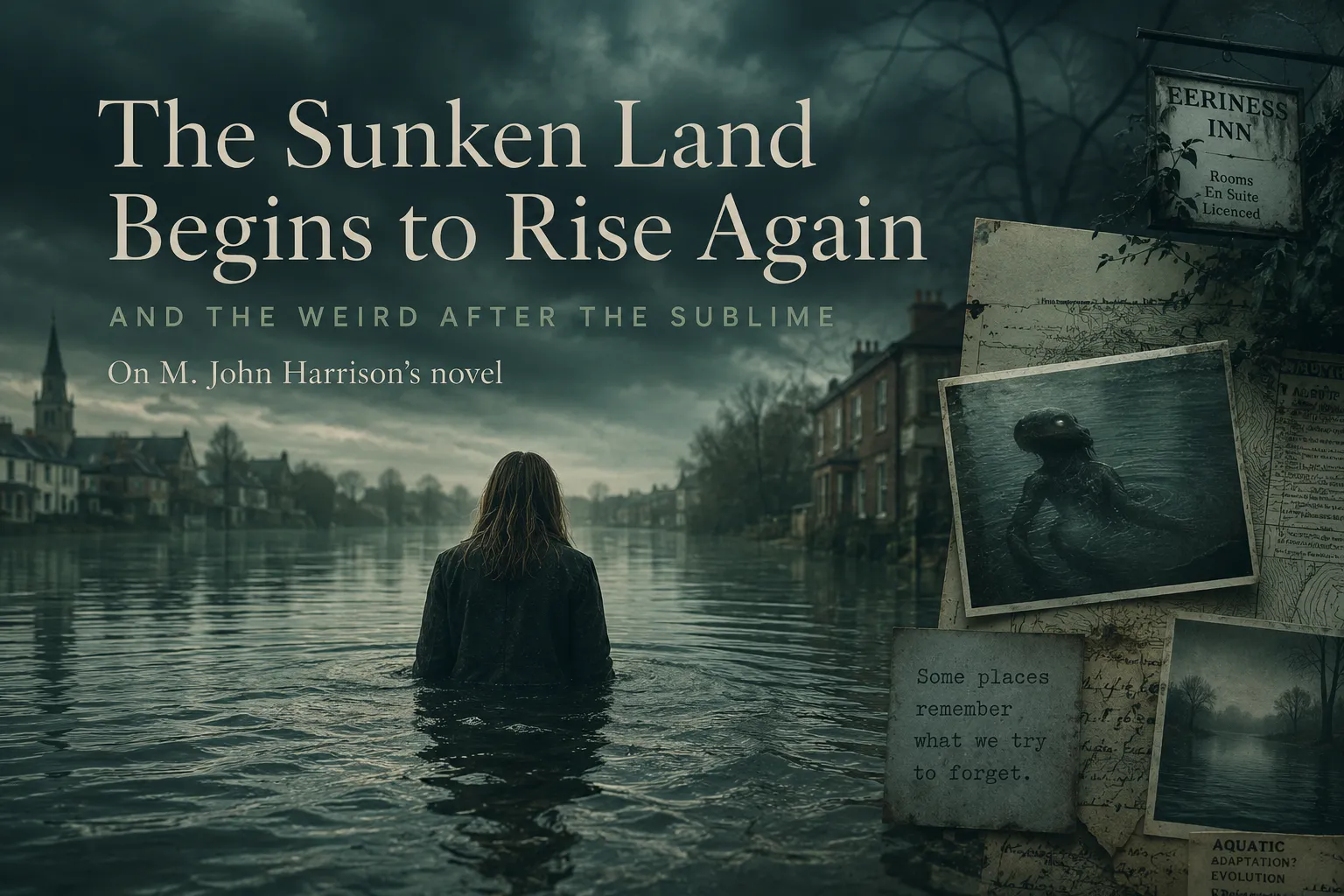
The Sunken Land Begins to Rise Again and the Weird After the Sublime
Introduction
In contemporary discussions surrounding weird fiction, the name of China Miéville occupies a central position not only as a novelist but also as a theorist of the genre. Across several essays, Miéville has repeatedly connected the weird to the sublime and to a secularized form of numinous experience: the encounter with something that exceeds human categories, producing fascination, terror, and ontological disorientation. Even stripped of religious transcendence, the weird would still preserve a structure of radical alterity, a destabilizing contact with an external "outside."
It is precisely here that M. John Harrison performs a decisive shift. The Sunken Land Begins to Rise Again retains many familiar elements of weird fiction — stagnant waterways, amphibious presences, humid landscapes, unstable perceptions, submerged histories — while simultaneously emptying them of metaphysical revelation. How Harrison achieves this transformation, and what it reveals about the possibilities of post-sublime weird fiction, is the central question this essay sets out to explore.
Lovecraft Without Revelation
The novel's aquatic imagery inevitably recalls The Shadow over Innsmouth. The amphibious undertones, the erosion of stable identity, and the sense that something submerged is slowly resurfacing all belong unmistakably to a Lovecraftian lineage. Yet Harrison transforms that inheritance in a fundamental way.
In Lovecraft, horror still opens onto cosmology. Beneath the surface of the world lies a hidden structure populated by ancient races, forbidden truths, and vast non-human temporalities. The human mind collapses under the pressure of an ontological excess it was never designed to process.
Harrison removes that moment of revelation entirely.
The aquatic creatures that drift through the novel never solidify into a coherent mythology. They remain intermittent presences encountered at the edges of perception: glimpsed in rivers, half-described in testimonies, embedded in fragments of conversation or obscure online material. Victoria's growing fascination with waterways and flooded landscapes never culminates in discovery. Shaw's drifting encounters with conspiracy theories and disconnected information produce not knowledge, but cognitive exhaustion.
The result is a strange inversion of the Lovecraftian model. The disorienting no longer comes from access to hidden truth, but from the impossibility of determining whether any truth exists beneath the accumulating signals at all.
Semiotics, Noise, and Cognitive Saturation
Throughout the novel, signs proliferate continuously. Documents, rumours, photographs, blog posts, coincidences, sightings, fragments of testimony, and recurring aquatic motifs seem constantly to imply the existence of some concealed pattern. Yet these elements never stabilize into an interpretative structure capable of organizing the narrative.
Harrison repeatedly places both the reader and the characters inside systems saturated with possible meaning but deprived of interpretative resolution. Shaw, in particular, drifts through a landscape of incomplete signals: vague conspiracies, disconnected archives, unstable social interactions, and online paranoia that never fully coheres into explanation. At one point, trying to trace the origins of a local myth about hybrid river-creatures, he finds himself lost in a thicket of contradictory forum posts and photocopied pamphlets, each one implying a connection the next refuses to confirm. The novel captures a distinctly contemporary cognitive condition in which interpretation continues compulsively even after the disappearance of any stable hermeneutic center.
This is where Harrison feels unexpectedly close to figures such as Baudrillard or Pynchon. The problem is no longer hidden truth, but informational excess. Hyperconnectivity generates opacity rather than intelligibility. Patterns appear everywhere, but no hierarchy of meaning can finally be established.
Importantly, Harrison does not merely describe this condition thematically. He reproduces it formally. The narrative persistently withholds convergence, avoids explanatory climax, and frustrates the reader's expectation that disparate elements will eventually connect. The novel begins to resemble an anti-detective story whose investigative machinery continues operating long after the possibility of resolution has evaporated. This formal dimension — the way the book's structure enacts the very cognitive paralysis it depicts — is arguably its most radical achievement.
Water as Anti-Form
These thematic and formal strategies are unified by the novel's governing principle: water. Water functions not simply as a symbol, but as the organizing logic of the whole. Identities blur, relationships dissolve, memory loses coherence, and causality itself becomes unstable. Scenes drift into one another with the same murky indistinctness that characterizes the flooded landscapes.
The comparison with The Drowned World is instructive, though Harrison abandons Ballard's visionary monumentalism. Ballard's apocalypse is spectacular, architectural, almost operatic in its grandeur. In Harrison, there is no dramatic civilizational collapse, no grand imagery of submerged skyscrapers. Instead, deterioration unfolds at low intensity, embedded within ordinary routines, failed conversations, exhausted relationships, and diffuse psychological unease. Water does not elevate experience toward the sublime. It slowly inundates the ordinary world from within, one unremarkable scene at a time.
A Weird of Immanence
This shift ultimately points toward one of the novel's most radical achievements. Weird fiction has historically retained some residual form of transcendence, even when negative or hostile. Writers as different as Lovecraft, Machen, Blackwood, Ligotti, and Miéville all imagine forms of alterity that exceed the human world from the outside — each in their own way, but all preserving the essential structure of an encounter with something beyond the boundaries of the known.
Harrison moves in a different direction.
The strange in The Sunken Land Begins to Rise Again does not arrive from elsewhere. It emerges from within contemporary reality itself — from informational overload, perceptual instability, emotional exhaustion, and the collapse of reliable distinctions between signal and noise, interior and exterior, paranoia and perception.
For this reason, the novel can be understood as a form of post-sublime weird fiction. The destabilizing no longer depends upon transcendence or cosmic revelation. Instead, it arises through the slow erosion of immanent reality.
Conclusion
What makes The Sunken Land Begins to Rise Again so disturbing is precisely its refusal to provide the unsettling reassurance of a hidden cosmic order — the cold comfort that, however terrifying, something lies beneath appearances waiting to be revealed. There is no final unveiling, no cosmic architecture waiting beneath appearances, no definitive revelation capable of reorganizing the chaos of signs.
The novel instead lingers within uncertainty itself.
Its world remains functional, recognizable, almost mundane, yet increasingly difficult to interpret with confidence. Meaning does not disappear dramatically; it erodes gradually through repetition, informational saturation, and perceptual ambiguity.
In that sense, Harrison may be describing a specifically contemporary form of the weird: not the terror of encountering an incomprehensible outside, but the quieter and more intimate experience of watching reality lose semantic stability from within.