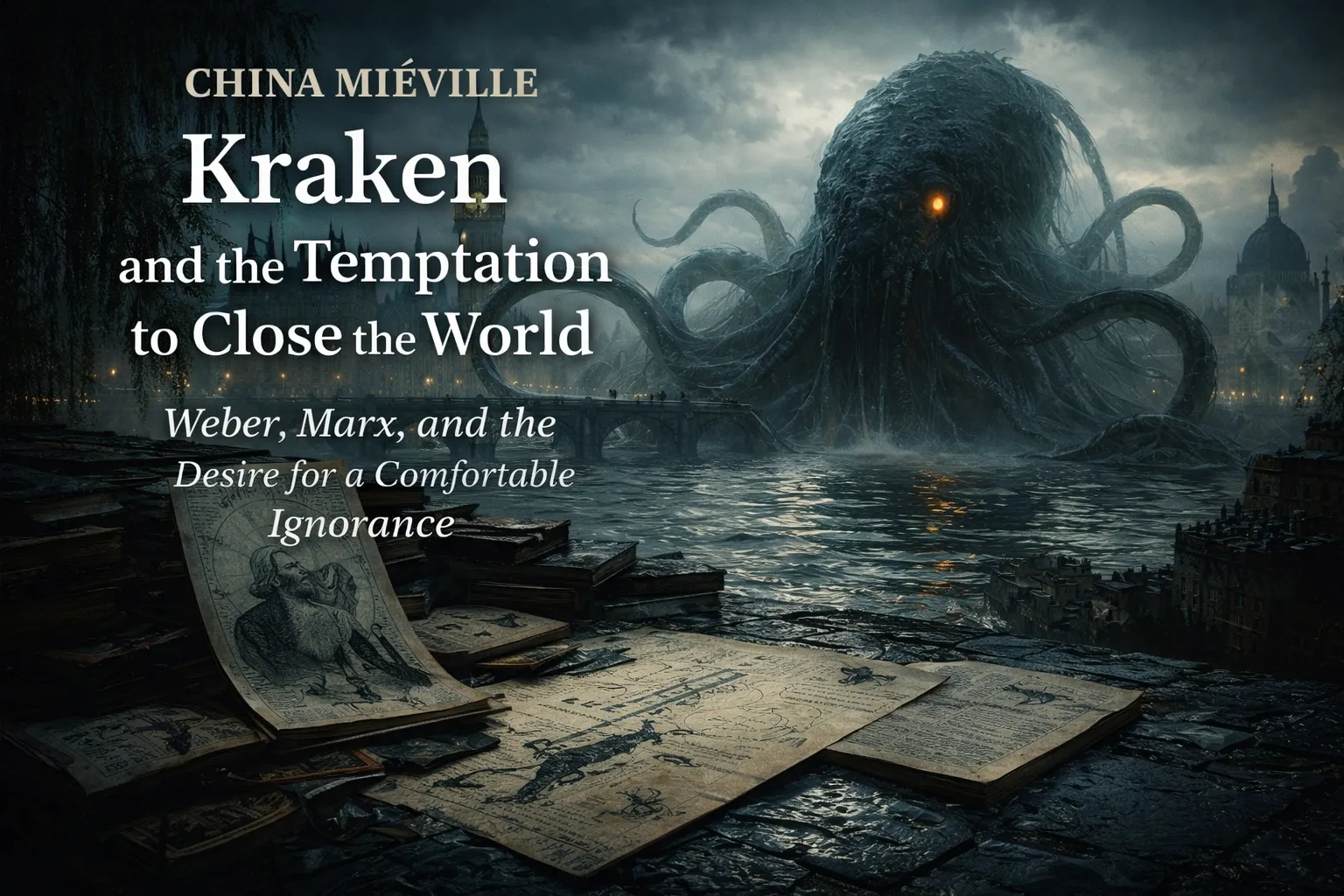
Kraken and the Temptation to Close the World
The Empty Tank
There is something profoundly deceptive about Kraken. At first, it appears to be a novel about a missing object—a preserved giant squid—and a London haunted by eccentric cults, apocalyptic sects, and distorted languages. A weird carnival, ultimately. But the ending performs a brutal turn: it was never about the monster. It was never even about the apocalypse.
It was about Darwin.
Or rather: it was about the very possibility of living in a Darwinian world.
The Kraken as a False Trail
The kraken is the perfect diversion. A narrative fetish that catalyzes attention, conflict, belief. Everyone searches for it, interprets it, desires it. And precisely for this reason, it is irrelevant: its meaning is entirely delegated to others.
What ultimately emerges is far more radical: the erasure of Darwin. Not the destruction of an object, but the sabotage of a paradigm. Not the end of the world, but the end of the possibility of understanding the world as process, mutation, contingency.
The apocalypse here is epistemological.
Weber: The Failure of Disenchantment
Read through Weber, the London of Kraken is a world after disenchantment. Everything has been rationalized: museums, police, taxonomies. And yet the sacred returns—not as an ordered system, but as uncontrolled proliferation.
The apocalyptic sects become the narrative form of the polytheism of values: each group holds an absolute truth, yet none can claim universality. The Congregation of Kraken holds the squid as divine totality; the Chaos Nazis worship entropy as destiny; the various minor cults orbit their own cosmologies, mutually incompatible and equally non-negotiable. There is no synthesis among them—only conflictual coexistence, each absolute rendered relative by the mere existence of the others.
Within this landscape emerges a deeply Weberian temptation: to escape the conflict of values. Not to choose among competing gods, but to eliminate them altogether—replacing complexity with a single, definitive order.
To erase Darwin is precisely this: to end the vertigo of contingency.
Marx: Ideology and Escape from Material Reality
But Weber is not enough. Kraken is also a deeply urban, material, social novel. And here Marx becomes indispensable.
The sects are not only systems of meaning; they are distorted forms of collective organization. Communities without praxis. Symbolic responses to real conditions of alienation.
Billy Harrow is the clearest embodiment of this contradiction. He is a specialist—a curator, a trained biologist, a man who knows the squid better than anyone—and yet his expertise grants him no power over the object of his knowledge. The moment the tank is emptied, his institutional role collapses entirely. What remains is a man whose only resource is a form of knowing that the world, it turns out, does not need in the way he imagined. His entire trajectory through the novel is an attempt to convert specialized knowledge into agency—and the repeated failure of that conversion is not personal. It is structural.
The London of Kraken is a city shaped by invisible labor and knowledge without power. In such a context, apocalypse becomes a shortcut: not to transform the world, but to imagine its end. Not to understand material relations, but to mythologize them.
From this perspective, the project revealed at the end is ideological in the strongest sense: it does not confront reality—it erases it.
Darwin as Scandal
But why Darwin?
Because Darwinism is not merely a scientific theory. It is an ontological scandal. It introduces a world without design, without guaranteed hierarchy, without intrinsic purpose—a world in which everything is mutable, contingent, unstable. A world, in other words, difficult to inhabit.
The implicit response the novel stages is both simple and terrifying:
better a false but stable world
than a true but unmanageable one.
The Contemporary Temptation
At this point, Kraken ceases to be just a weird novel and becomes a lens on the present—though not in the way a thesis would have it.
Miéville does not offer a diagnosis. He offers a structure. And the structure is recognizable.
What does it mean, today, to choose simplicity over complexity—not out of ignorance, but deliberately? What is the relationship between the desire for a closed narrative and the material conditions that make open ones unbearable? When does the rejection of contingency become a political act rather than a cognitive failure?
The novel does not answer these questions. It stages them. And perhaps that is the more honest gesture: to show that the temptation is not pathological, not marginal, not other—but latent in anyone who has ever found the world too difficult to inhabit as it actually is.
Better Not to Know?
The power of Kraken lies in the fact that it does not dismiss this position as mere madness. It renders it understandable.
To live in a Darwinian world is to accept that no ultimate meaning is guaranteed, that change is constant, that nothing is definitively grounded. This is an existential condition before it is a scientific one.
And so the novel leaves us with an uncomfortable question:
how much truth are we really willing to tolerate,
if it makes the world harder to inhabit?
Conclusion: Closing or Inhabiting Chaos
In the end, Kraken is not a novel about the occult. It is a novel about a choice: to close the world, reduce it, simplify it, render it narratively stable—or to accept its complexity, contradiction, and mutability.
Weber would tell us there is no synthesis of values. Marx would remind us that the problem is material, not only symbolic. Darwin, silently, shows that the world does not need us in order to change.
Miéville holds all of this together and refuses consolation.
The true horror of Kraken is not the monster. It is the possibility that, faced with the complexity of reality, we might choose—deliberately—not to see anything at all.