Annihilation and the Trauma of Alterity
Area X, Symbolic Collapse, and the Transformation of the Human
Introduction
Much of the criticism surrounding Annihilation by Jeff VanderMeer has approached the novel through the lenses of ecocriticism, posthumanism, or the epistemological limits of scientific rationality. These interpretations are well founded. Area X appears as a space in which the distinction between human and nonhuman progressively dissolves, while scientific language becomes increasingly incapable of restoring intelligible order to reality. Yet such readings sometimes risk reducing the novel to an ecological allegory or a meditation on environmental collapse. What makes Annihilation genuinely unsettling is not simply the existence of an alien ecosystem, but the way contact with Area X destabilizes the symbolic structures through which human beings produce meaning and identity.
The members of the Southern Reach expedition enter Area X convinced that they can observe, classify, and describe what they encounter. They bring with them the cognitive apparatus of modernity: taxonomies, scientific protocols, linguistic precision, institutional authority. Yet the novel quickly reveals that the problem is not merely the presence of something unknown. Area X destabilizes the categories that make knowledge itself possible. Objects continue to exist materially, but cease to occupy stable positions within the symbolic order that once rendered them intelligible.
It is here that the novel acquires a deeply anthropological dimension. As Émile Durkheim argued, the categories through which human beings organize reality are not natural, but socially produced structures of meaning. VanderMeer radicalizes this insight by imagining an encounter capable of dissolving those structures entirely. The contamination described throughout the novel is therefore not merely biological. It is semiotic, ontological, and identitarian. Contact with alterity transforms the subject because it destabilizes the symbolic system through which the subject understood itself in the first place.
The Tower and the Crisis of Classification
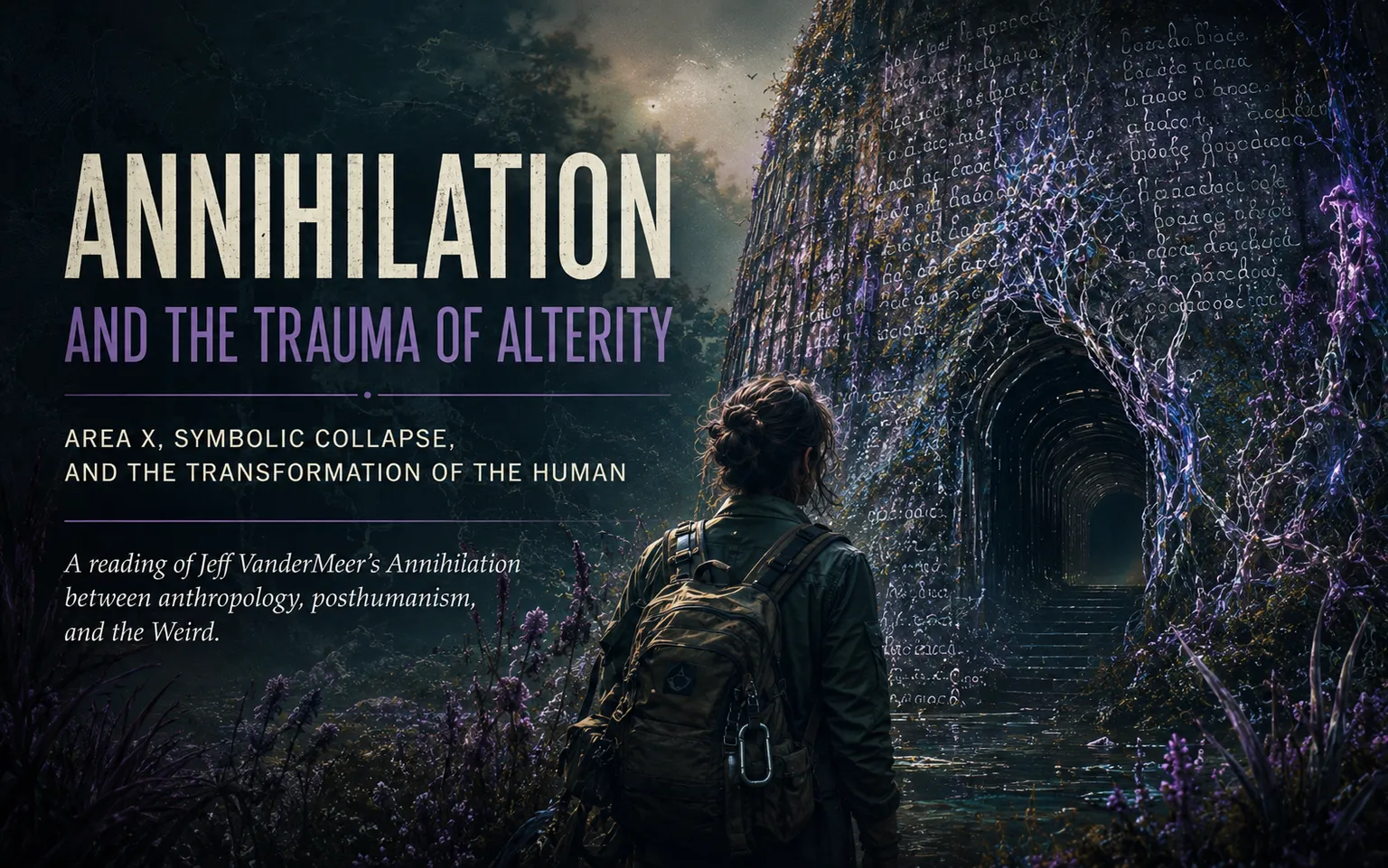
One of the most revealing moments in the novel concerns the structure the expedition insists on calling a "tower," despite the biologist's persistent perception that it is in fact a tunnel descending into the earth. The disagreement appears minor at first, yet it quietly destabilizes the entire epistemological framework of the expedition.
The naming of the structure becomes an attempt to impose symbolic stability upon an object that resists categorization. Calling it a tower preserves orientation, hierarchy, and distance. A tower rises; it remains visible and architecturally legible. A tunnel, by contrast, implies descent, enclosure, and loss of perspective. The tension between these terms reveals that language in Annihilation does not simply describe reality, but actively organizes what reality can appear to be.
This is precisely where VanderMeer's anthropological dimension emerges most clearly. The expedition behaves as though classification could stabilize the unknown. Yet the structure continuously exceeds the categories imposed upon it. The problem is not merely that Area X contains unfamiliar objects, but that familiar symbolic distinctions no longer function reliably within it.
The text written along the walls of the tower intensifies this crisis further. The living script — simultaneously fungal, biological, and linguistic — dissolves the modern separation between language and matter. The words are not inscribed onto the environment as passive signs. They grow organically out of it. Meaning itself becomes biological proliferation.
The implications extend beyond epistemology. The biologist does not merely observe the living text from a safe analytical distance: she inhales its spores. The act of reading becomes an act of contamination. What enters through the eyes and lungs is not simply information but a reorganization of the perceptual apparatus itself. Language, in this scene, ceases to function as transparent mediation between subject and world; it becomes instead a material process that begins rewriting the subject from within. This is the precise hinge between the collapse of classification in the tower and the dissolution of subjective continuity that will follow.
The Biologist's Journal and the Dissolution of the Self
If the tower stages the collapse of classification, the biologist's journal stages the collapse of subjective continuity. Throughout the novel, writing initially appears as a technology of stabilization. The journal allows the biologist to document observations, preserve rational distance, and maintain coherence against the destabilizing effects of Area X.
Yet the diary progressively becomes an archive of dissolution rather than control.
As the biologist undergoes contamination, her observations grow increasingly uncertain. Perception itself becomes unstable. Memories detach from chronology, emotional responses flatten or intensify unpredictably, and distinctions between inner and outer reality begin to erode. The journal remains materially intact, but the subject writing within it no longer coincides with the subject who began the expedition.
This transformation is crucial because it reveals that identity in Annihilation is inseparable from symbolic continuity. The self exists only insofar as experience can be organized narratively through stable cognitive categories. Once Area X destabilizes those categories, the continuity sustaining the subject begins to fracture.
The novel therefore treats contamination not primarily as bodily corruption, but as symbolic dislocation. The body changes because the symbolic system that once rendered it intelligible as "human" has collapsed. VanderMeer repeatedly suggests that the subject cannot survive intact once the structures organizing perception and meaning begin to dissolve.
At this point, the novel comes close to certain postcolonial theories of hybridity and commingling. Yet VanderMeer sharply diverges from more optimistic models of hybrid identity. In thinkers such as Homi Bhabha or Édouard Glissant, the encounter between incommensurable symbolic systems can produce a generative third space — a site of negotiation, opacity, or relational identity that, however unstable, remains habitable. The third space is traumatic in origin but productive in outcome. Area X refuses this logic entirely. What it produces is not a negotiated position between two symbolic orders but the collapse of the conditions under which negotiation could occur. Transformation here is not synthesis but the permanent destabilization of the previous self, without guarantee of what, if anything, replaces it.
Southern Reach and the Failure of Modern Epistemology
The institutional structure of the Southern Reach attempts constantly to restore epistemological distance from Area X. Every expedition generates reports, classifications, recordings, psychological evaluations, and archives. Before entering, members undergo hypnotic conditioning designed to suppress autonomous perception and secure behavioral compliance. The border itself is militarized and bureaucratically managed. Knowledge becomes an administrative operation.
Yet the novel insists on the futility of this process. The journals of previous expeditions, preserved in the Southern Reach's files, reveal a pattern of progressive incoherence: precise early entries giving way to fragmented observations, abrupt silences, and finally the disturbing physical return of subjects who no longer recognize themselves. The more information Southern Reach accumulates, the less intelligible Area X becomes. Institutional observation fails not because the phenomenon is insufficiently studied, but because the act of observation itself becomes unstable within the altered symbolic conditions of Area X.
Read in this way, the expeditions resemble impossible ethnographic missions. The observers assume they can remain external to the phenomenon they study, yet contact irreversibly transforms them. The separation between observer and observed — foundational to modern scientific epistemology — progressively collapses.
This is one of the novel's most disturbing implications. Area X does not merely resist knowledge; it transforms the conditions under which knowledge can exist. Scientific rationality appears less as a universal instrument than as a historically contingent symbolic structure suddenly confronted with its own limits.
Beyond Lovecraft: The Weird and the Transformation of the Human
For this reason, VanderMeer's weird differs significantly from both classical cosmic horror and traditional first-contact science fiction. In Lovecraft, the encounter with alterity typically reveals the insignificance of humanity before an incomprehensible external cosmos. The human subject may descend into madness, but the self generally remains structurally intact as the site of horror.
In Annihilation, by contrast, alterity does not remain external. Area X contaminates, rewrites, and reorganizes the subject itself. Horror emerges not from the mere existence of the unknown, but from the dissolution of the symbolic structures that once allowed the human to recognize itself as human.
The difference becomes especially visible when compared with Stanisław Lem's Solaris. In Lem, the alien exceeds human comprehension because it cannot be translated into recognizable conceptual categories. The human subject remains cognitively intact, even as understanding proves permanently out of reach. VanderMeer radicalizes this problem further. In Annihilation, contact with alterity destabilizes the categories through which comprehension itself was possible. The problem is no longer simply that the alien cannot be understood, but that the subject capable of understanding begins to dissolve.
This is what ultimately situates Annihilation within the New Weird tradition. The weird is not simply the eruption of monstrosity into reality. It is the collapse of the symbolic order that once made reality appear stable and intelligible.
Conclusion: The Impossibility of Returning
By the end of the novel, the biologist chooses not to return from Area X. This decision is crucial because it prevents the narrative from restoring symbolic equilibrium. The transformation she undergoes cannot be reintegrated into the previous order of meaning.
Area X does not merely produce new identities; it renders return impossible. The subject that entered the border no longer exists in recognizable form. The novel therefore refuses the consolations of reconciliation, cure, or epistemological mastery. Transformation leaves no stable ground upon which the old symbolic order can be reconstructed.
It is perhaps here that Annihilation reaches its most unsettling dimension. The novel suggests that contact with alterity never leaves the subject intact because identity itself depends upon fragile symbolic systems that can collapse under sufficient pressure. What disappears in Area X is not simply the boundary between human and nonhuman, but the symbolic architecture through which humanity once understood itself at all.
Further Reading
- Joshua Rothman, The Weird Thoreau
- Simon Ings, Annihilation review – "You'll find yourself afraid to turn the page"
- Dan Hartland, Annihilation by Jeff VanderMeer
- Studies on posthumanism and ecocriticism applied to the Southern Reach Trilogy
Implicit Theoretical References
- Émile Durkheim
- Homi K. Bhabha
- Édouard Glissant
- Stanisław Lem