Beyond Fantasy: Narrative Topology and Spatial Imagination in Titus Groan
Introduction: The Castle as Narrative Problem
Critical discussions of Mervyn Peake's Titus Groan have traditionally focused on questions of genre. The novel has been variously classified as fantasy, gothic fiction, satire, and literary modernism, yet none of these labels fully captures the peculiar experience it offers its readers. What makes Titus Groan distinctive is not primarily the nature of its fictional world, nor the eccentricity of its characters, but the way it organizes perception.
Readers often discover that their attention is drawn less toward the resolution of conflicts than toward the progressive revelation of Gormenghast itself. The desire to know what lies beyond a staircase, behind a door, at the end of a corridor, or atop a forgotten tower frequently becomes more compelling than the desire to know what will happen next. This shift in narrative emphasis suggests that the novel may be approached through a different critical framework.
I propose reading Titus Groan as an example of narrative topology: a form of storytelling in which spatial relations acquire a structural function traditionally occupied by temporality and causality. In such narratives, space is not merely the container of events. It becomes the principal mechanism through which narrative meaning is generated.
Seen from this angle, Peake's achievement lies in the creation of a narrative architecture that combines Dickensian characterization, an intensely visual imagination, and an exploratory mode of reading that anticipates concerns later visible in writers such as Georges Perec and, in a different medium, Peter Greenaway. The central question is therefore not whether Titus Groan belongs to fantasy, but how its spatial organization transforms the act of reading itself.
Gormenghast as Narrative Machine
The opening movements of Titus Groan establish a pattern that will govern the entire novel. Rather than introducing a central conflict and progressively developing its consequences, Peake first immerses the reader in a physical environment whose scale and complexity seem to exceed immediate comprehension.
The castle appears not as a setting awaiting occupation but as an autonomous presence. Long before the reader acquires a clear understanding of the social structures that govern Gormenghast, one encounters towers, halls, parapets, rooftops, and corridors. The architecture possesses a narrative density usually reserved for characters.
The novel's opening pages make this priority explicit. Before any character is properly introduced, before any conflict is established, Peake devotes sustained attention to the castle's external mass and its surrounding geography: the vast walls, the towers of various heights and degrees of ruin, the stone kitchens, the endless and partially collapsed outbuildings. The reader is given a census of architecture before a census of inhabitants. When Titus's birth is finally announced, it arrives as an event within a space already partially known—not as the origin point from which a world will gradually be constructed.
In a conventional novel, architecture often serves to support narrative action. In Titus Groan, narrative action frequently serves as a means of exploring architecture. Characters move through the castle not merely to advance the plot but to disclose new dimensions of the environment. The most sustained demonstration of this principle is Steerpike's ascent through forgotten spaces and neglected architectural zones. His movement matters not only because it advances his personal ambitions, but because it introduces the reader to regions of Gormenghast that would otherwise remain inaccessible.
The sequence in which Steerpike escapes from the kitchens and makes his way upward through the castle's abandoned upper levels is among the most spatially concentrated in the novel. His movement is driven by ambition, but the reader's attention is captured by something else: the gradual disclosure of zones that appear to exist outside any active social or ritual function. The attics, the forgotten corridors, the rooftop terraces overlooking the lower castle—these spaces are presented with the same descriptive intensity as the inhabited rooms below, yet they belong to no one and serve no ceremony. Their existence implies a castle far larger than any map of its social life would suggest.
What sustains attention in these passages is not primarily the question of whether Steerpike will succeed, but the gradual unveiling of the castle itself. Narrative energy derives less from causal stakes than from spatial discovery.
This dynamic invites comparison with Georges Perec's Life: A User's Manual, another work in which architecture functions as a generator of narrative possibility. Yet the differences are as revealing as the similarities. Perec's apartment building ultimately remains intelligible; its complexity can be reconstructed through patient analysis. Gormenghast resists such reconstruction. The castle appears less designed than accumulated. New spaces emerge without contributing to a sense of totality. The reader gains local knowledge while remaining unable to grasp the structure as a whole. Where Perec's architecture encourages mapping, Peake's encourages exploration—and that distinction marks a fundamental difference in the kind of reading each work demands.
Visibility and the Painterly Gaze
The centrality of space also helps explain the extraordinary visual intensity of Peake's prose.
Readers of Titus Groan often retain vivid memories of images while struggling to reconstruct the precise sequence of events associated with them. A figure crossing a rooftop, a silhouette framed against a window, a ritual unfolding within an immense hall—such images persist in memory with unusual force. This characteristic recalls what Italo Calvino would later describe as the literary power of visibility. Yet Peake's visual imagination differs from the kind of image-making found in much modernist fiction. His images are not primarily symbolic or psychological. They are spatial.
Characters are rarely understood through sustained interior monologue. Instead, they are encountered through position, gesture, movement, and physical relation to their surroundings.
The repeated scenes involving Flay's nocturnal movements through the castle's corridors are instructive here. Flay is rarely explained; he is observed. His significance accumulates through the image of his elongated silhouette moving through darkened passageways, through the sound of his knee-joints cracking against stone, through his habitual positioning at thresholds—doorways, archways, the edges of rooms—rather than at their centres. He is a figure who belongs to the transitional spaces of Gormenghast, and it is that spatial belonging, more than any psychological account, that constitutes his character.
This visual emphasis reflects Peake's formation as an illustrator, but it also contributes directly to the novel's topological structure. The reader's understanding develops through observation rather than introspection. Narrative meaning emerges through acts of seeing.
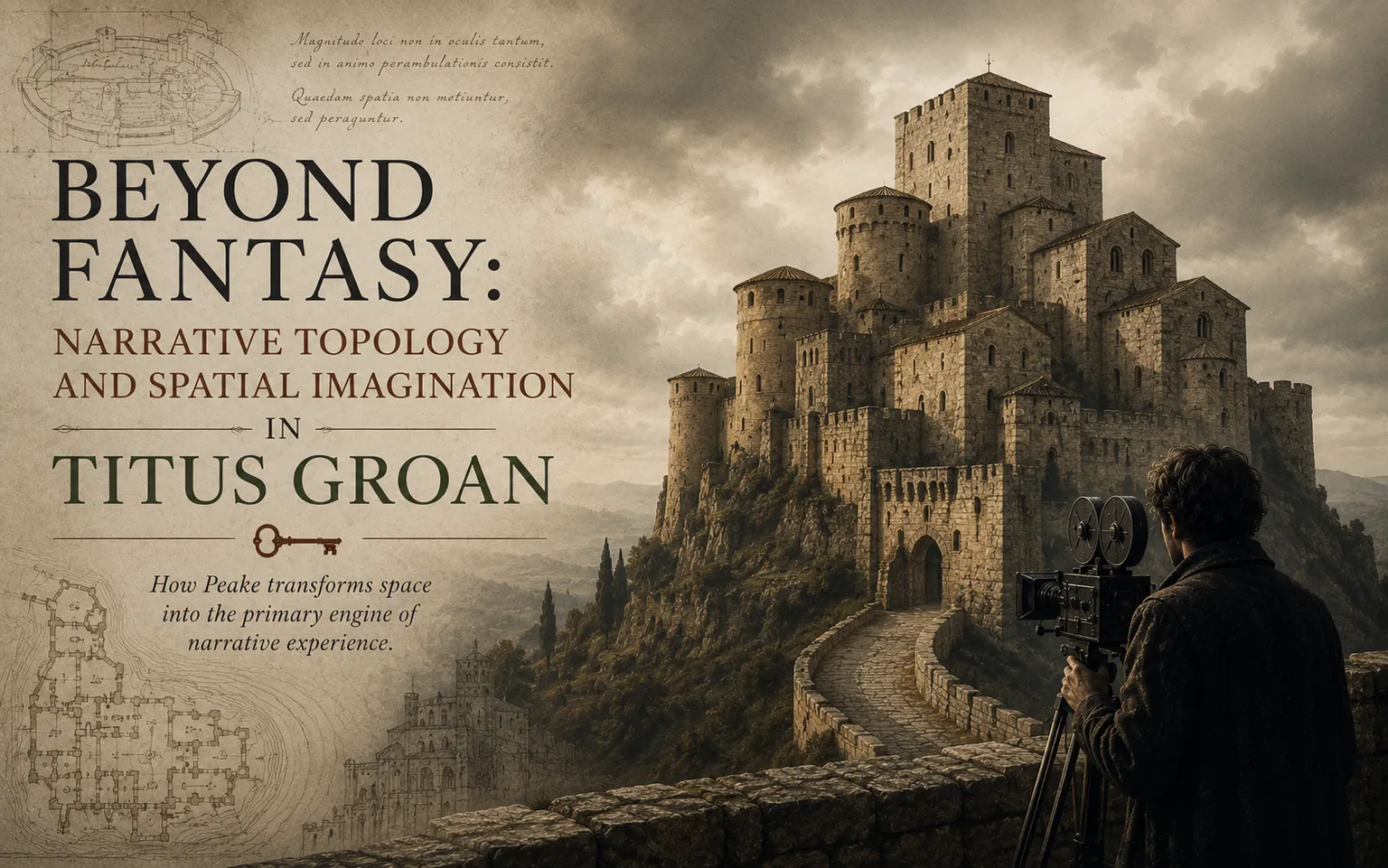
It is perhaps for this reason that many readers report a curious sensation while reading Titus Groan: the feeling of standing behind a camera. One is not primarily inhabiting consciousness. One is observing figures moving through a vast and continuously unfolding architectural environment.
Dickensian Figures in a Topological World
This visual logic extends to the treatment of character. The inhabitants of Gormenghast can be situated within a recognizable literary tradition: characters such as Steerpike, Flay, Swelter, Prunesquallor, and Sepulchrave owe much to Dickensian modes of characterization. Like Dickens's great eccentrics, they are defined through external traits, recurrent gestures, distinctive physical presences, and memorable behavioural patterns. Their individuality emerges less from psychological depth than from formal distinctiveness.
Peake modifies this inheritance in one crucial way. In Dickens, eccentric characters are typically embedded within the social complexity of the city. In Titus Groan, they are embedded within an architecture. The castle becomes the medium through which character is revealed. Flay's rigid physicality, Swelter's grotesque corporeality, and Steerpike's restless mobility all acquire significance through their relationship to specific spaces within Gormenghast.
The confrontation between Flay and Swelter in the Hall of Spiders is a scene organized almost entirely through spatial logic. The vast, cobwebbed hall functions less as backdrop than as a third presence: its dimensions determine the pace of the encounter, its darkness calibrates the reader's perception of the two figures, and its remoteness from the inhabited castle signals that what occurs there will leave no institutional trace. The characters are not simply in a space; they are produced by it. Swelter's bulk and Flay's angularity acquire their full meaning only within the proportions of that particular room.
This spatialization of character is where comparisons with Peter Greenaway become illuminating. Both Peake and Greenaway approach narrative through composition: characters function not merely as agents of action but as visual elements positioned within larger spatial arrangements. What matters is not simply who these figures are, but where they are and how they occupy the frame.
The Weird Geometry of Gormenghast
The notion of narrative topology becomes particularly useful when considering the strange atmosphere that permeates the novel—and the reason why Gormenghast so often resists the fantasy label despite occupying broadly similar territory.
Peake displays remarkably little interest in the features that later came to define the genre. There is no systematic worldbuilding, no detailed cosmology, and no explanatory mythology capable of integrating every aspect of the fictional world into a coherent whole. Instead, the castle remains stubbornly opaque. Its rituals possess authority but uncertain origins. Its geography appears vast but impossible to fully reconstruct. Its social order is elaborate but only partially intelligible.
This is precisely the condition that the mapping/exploration distinction points toward. Gormenghast cannot be mapped because its total logic is never disclosed. The reader is always exploring, never arriving at comprehensive understanding. This opacity is not an accidental by-product of the narrative. It is one of its primary effects.
The ritual sequences surrounding the Stone Lanes ceremony and the Breakfast Gathering of the Countess are characteristic in this respect. Peake describes their performance with meticulous attention to gesture, sequence, and spatial arrangement—who stands where, how objects are handled, what order governs movement—yet their origins and ultimate significance remain unexplained. The ceremonies carry enormous weight within the social world of Gormenghast, but the reader is never offered the explanatory mythology that would convert that weight into legible meaning. The detail is precise; the purpose is opaque. That combination, sustained across hundreds of pages, produces an environment that feels inexhaustibly real and permanently unknowable at the same time.
The source of estrangement is not supernatural intrusion but cognitive incompleteness. The castle remains perpetually larger than the reader's understanding of it. In this sense, Gormenghast anticipates a form of weirdness that would later become central to writers such as China Miéville and Jeff VanderMeer: a weirdness generated not by monsters but by environments whose total logic remains inaccessible.
Conclusion: Exploring the Castle
To read Titus Groan is, in a sense, to wander through the castle behind a camera, discovering its hidden geography one frame at a time. The novel never delivers the satisfaction of full comprehension. The reader advances through Gormenghast as an explorer advances through an unknown territory, assembling fragmentary knowledge while never fully mastering the landscape. That experience of perpetual, productive disorientation—more than any question of genre—may be the key to understanding the enduring singularity of Peake's masterpiece.
Further Reading and Viewing
- Peake, Titus Groan
- Calvino, Six Memos for the Next Millennium
- Perec, Life: A User's Manual
- Greenaway, The Draughtsman's Contract