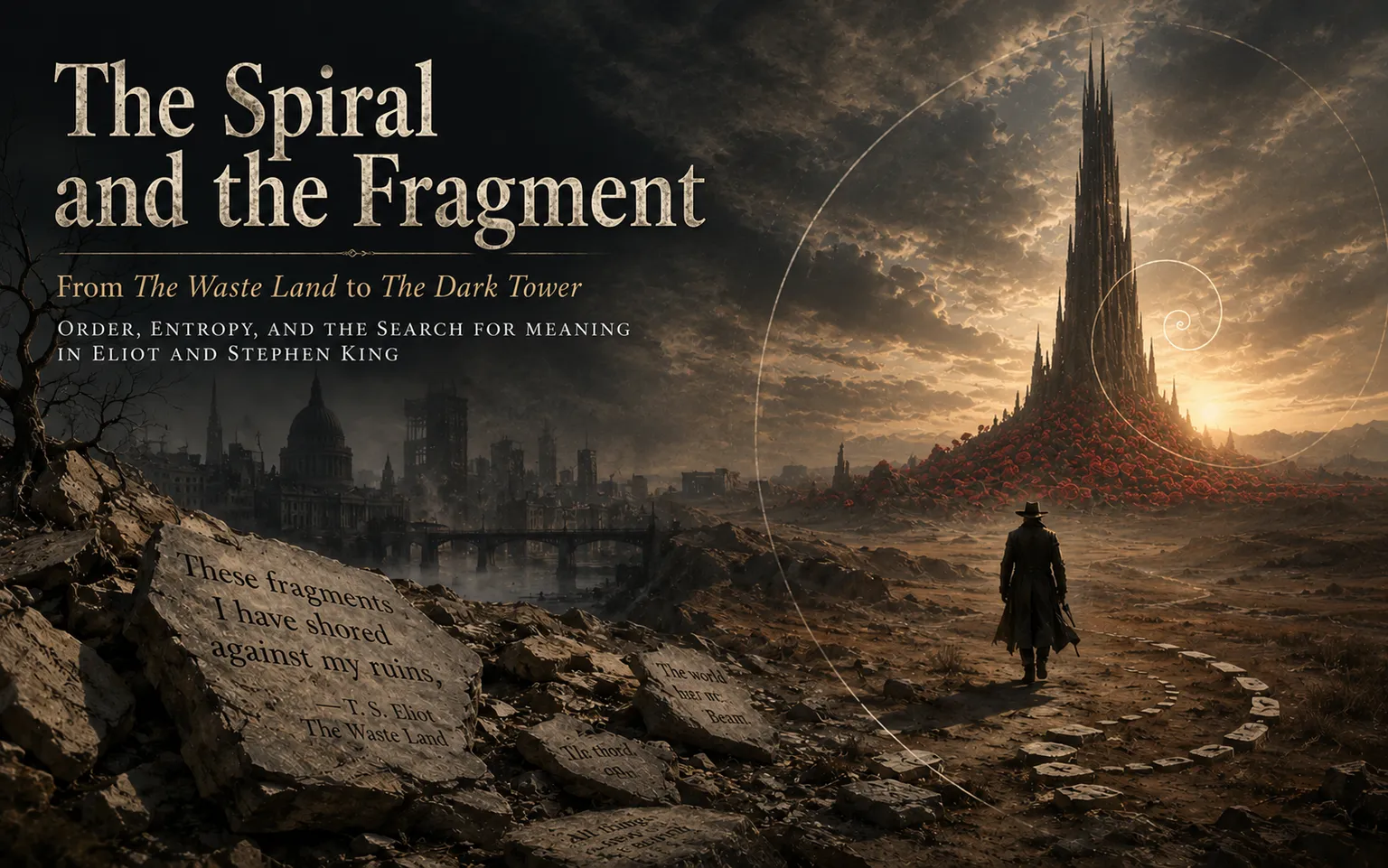
The Spiral and the Fragment: From The Waste Land to The Dark Tower
Introduction
The references to T. S. Eliot’s The Waste Land within Stephen King’s Dark Tower saga are unmistakable. The third volume of the series is significantly titled The Waste Lands, and many readers have noted King’s debt to modernist imagery. Yet reducing the relationship between the two works to a matter of influence risks overlooking its most interesting dimension. What Eliot and King share is not merely an aesthetic of ruins, but a deeper meditation on the problem of order in a universe shaped by disintegrative forces.
This question is particularly significant because The Dark Tower occupies a unique position within King’s body of work. Although it is neither his most widely read nor his most commercially successful project, it gradually becomes the gravitational center of his fictional universe. Novels such as 'Salem’s Lot, Insomnia, Hearts in Atlantis, Black House, and The Stand are all drawn, in different ways, into the orbit of the Tower. Yet this center does not function as a stable foundation. The more the reader attempts to understand it, the more it dissolves into new stories, new connections, and new ambiguities.
In both Eliot and King, readers move through worlds that seem to have passed beyond their point of equilibrium and are slowly sliding toward dissolution. The difference is that Eliot presents this condition as a cultural and symbolic crisis, whereas King transforms it into the engine of narrative itself. Read from this perspective, The Dark Tower can be understood as a narrative response to a question left unresolved in The Waste Land: what does it mean to continue searching for forms of order within a world governed by entropy?
The Waste Land and Cultural Entropy
Critics have often described The Waste Land as the great poem of Western crisis. While this definition captures an essential aspect of the text, it remains too broad to explain the nature of Eliot’s desolation. The wasteland is not simply the result of moral decline, nor is it merely a lament for lost values. The landscape of the poem is not empty. On the contrary, it is crowded with presences.
Dante’s voice intersects with Shakespeare’s, the Grail myth coexists with Buddhism and contemporary London conversations, and fragments from multiple traditions accumulate throughout the poem. The reader encounters not the absence of meaning but a proliferation of meanings that can no longer be organized around a shared center. Even Eliot’s celebrated “mythical method” appears to function ambiguously. Myth promises order, yet the poem continues to generate fragmentation.
From this perspective, the poem’s closing gesture is particularly revealing: the speaker’s explicit acknowledgment that the surviving fragments of tradition have been gathered and propped up against the ruin of meaning. The fragments of tradition have not disappeared. What has vanished is the principle capable of transforming them into a coherent whole. The wasteland is not the desert of absence but the landscape of excess. Remnants of the past continue to emerge everywhere, yet they appear as residues surviving beyond the structures that once gave them meaning.
The crisis represented by Eliot may therefore be described as a form of cultural entropy. The issue is not the destruction of cultural elements themselves, but the gradual dissolution of the relationships that once connected them. Entropy does not eliminate the fragments; it eliminates the network that held them together.
From Browning to King: The Waste Land Becomes a World
This image of disintegration forms one of the most interesting points of contact with The Dark Tower. The genealogy linking Eliot to King naturally passes through Robert Browning’s Childe Roland to the Dark Tower Came, a text fundamental to the creation of Roland Deschain and the imagery of the Tower itself. Yet if Browning provides King with the model of the wandering knight and the obsessive quest for an enigmatic destination, Eliot seems to offer something different: a vision of the world as a field of ruins and fragments.
The Mid-World traversed by Roland can be read as a narrative materialization of Eliot’s Waste Land. The saga’s recurring refrain about a world that has slipped past the structures which once organized it describes a reality in which the process of dissolution has extended beyond institutions and cultures to affect the very structure of existence.
The Great Old Ones have vanished. Their machines continue to operate, though no one fully understands their purpose. Cities survive beyond their original function, technologies persist after their meaning has been forgotten, and infrastructures slowly decay into landscapes of debris. Lud, crossed by Roland and his ka-tet in The Waste Lands, offers perhaps the most complete image of this condition: a metropolis that retains the forms of civilization while having lost the system that once gave those forms coherence.
Figures such as Blaine the Mono embody this situation almost perfectly. Blaine continues to function, but he has lost the purpose that justified his existence. He possesses information, memory, and computational power, yet lacks any meaningful end. Like many of the objects inhabiting Eliot’s Waste Land, he appears as a form that has survived the principle that created it.
The Tower and the Problem of Order
At this point, a crucial difference emerges between the two works. In Eliot, fragmentation is primarily a diagnosis. The poem presents a world in which meaning has dispersed and leaves open the question of whether any form of reintegration remains possible. In King, by contrast, entropy becomes the central problem that narrative must confront.
The entire Dark Tower saga can be read as an attempt to imagine what happens when a reality threatened by dissolution continues to search for forms of order. This threat takes concrete form in the gradual deterioration of the Beams, the structures supporting the universe and converging upon the Tower. Their erosion represents more than a physical danger. It symbolizes the weakening of the connections that hold the world together.
It would be a mistake, however, to identify this order with the Tower itself. At first glance, the Tower appears to be the foundation of King’s universe, the point from which all connections radiate and toward which all stories converge. Yet readers gradually discover that it does not function as a traditional metaphysical origin.
The closer one comes to the Tower, the less it offers definitive explanations. Its nature remains elusive. It can never be reduced entirely to a cosmic machine, a deity, or a simple symbol. The Tower promises a center while continually withdrawing from full comprehension.
In this sense, King’s cosmology differs sharply from those constructed by writers such as Tolkien. In Middle-earth, every element ultimately occupies a place within a relatively stable ontological structure. In The Dark Tower, every attempt to reach a foundation leads instead to further narrative layers. Behind one story lies another; behind every explanation, a new mystery emerges. The result is a cosmology that seems to aspire to totality while never fully granting it.
Ka-Tet and Emergent Order
Paradoxically, the true principle of order in the saga is not the Tower but the ka-tet. Roland, Eddie, Susannah, Jake, and later Oy form a temporary configuration that resists the world’s disintegrative forces.
Their significance derives not only from their role in the plot but also from their symbolic function within the narrative universe. In a cosmos constantly tending toward dispersion, the ka-tet represents a local form of cohesion. Order appears here not as an eternal and immutable structure but as a fragile and contingent relationship.
This distinction is fundamental. The Tower preserves the cosmos. The ka-tet preserves the human.
Throughout the saga, Roland repeatedly discovers that his obsession with the Tower has led him to sacrifice people, friendships, and emotional bonds. The journey therefore acquires a moral dimension. The underlying question is not simply how to save the world, but what price can justifiably be paid in order to save it.
The Ending of the Saga: Not a Circle but a Spiral
This perspective also allows for a reconsideration of the saga’s controversial ending. Many interpretations have viewed the conclusion of The Dark Tower as a version of eternal recurrence, since Roland, after reaching the Tower, is returned to the beginning of his quest.
Yet the detail of the Horn of Eld complicates such a reading. When Roland once again finds himself in the desert pursuing the Man in Black, he possesses something he did not have at the beginning of the series. The horn, lost at Jericho Hill, has somehow survived the cycle.
Roland begins again, but he does not begin again unchanged.
The geometric figure suggested by this ending is therefore not the circle but the spiral. Roland returns to a seemingly familiar position, yet each iteration introduces a difference. The movement leads neither to definitive redemption nor to immutable damnation. Instead, it suggests a process of gradual and almost imperceptible transformation.
Nothing guarantees that this transformation will ever be completed. Nor can the possibility be excluded that the cycle has already repeated itself countless times before the opening pages of the first novel. What the text does suggest is that each iteration may preserve something from the previous one: a memory, a wound, a fragment.
Conclusion
It is here that the dialogue with Eliot reaches its most compelling point. If the fragments of The Waste Land testify to what survives after the collapse of a cultural order, the Horn of Eld performs a similar function within King’s saga. It too is a fragment rescued from ruin. It too moves through time carrying the memory of what has been lost.
The difference is that, whereas Eliot leaves uncertain whether fragments can generate a new form of meaning, The Dark Tower suggests that they can at least alter the trajectory of the world.
This same restlessness operates beyond the seven novels of the saga itself. The Tower’s pull on works such as ‘Salem’s Lot, Insomnia, Hearts in Atlantis, Black House, and The Stand reproduces, across King’s wider fictional universe, the same condition Eliot diagnosed within a single poem: a center that generates proliferation rather than containing it. The closer the reader is drawn toward the Tower as an organizing principle, the more material accumulates around it — additional novels, intersecting timelines, recurring figures displaced across different fictional worlds. Whether such an expanding system could ever stabilize into a genuine totality, or whether it is structurally condemned to keep multiplying fragments, is a question the saga’s own scale leaves open.
Read in this light, the spiral describes not only Roland’s individual fate but the rhythm of King’s fictional system as a whole. Every apparent closure — the end of the quest, the end of a novel, the end of the saga itself — turns out to generate a new opening elsewhere in the larger architecture. Eliot’s poem ends by acknowledging that its fragments have been gathered against ruin without specifying what, if anything, might come of the gesture. King’s saga answers by multiplying that same gesture across an entire fictional cosmos: not a final form of order, but order’s perpetual, unfinished attempt to reconstitute itself out of what entropy leaves behind.
Further Reading
- Robert Browning, Childe Roland to the Dark Tower Came.
- T. S. Eliot, The Waste Land.
- T. S. Eliot, “Ulysses, Order, and Myth”.
- Stephen King, The Gunslinger.
- Stephen King, The Waste Lands.
- Stephen King, The Dark Tower.