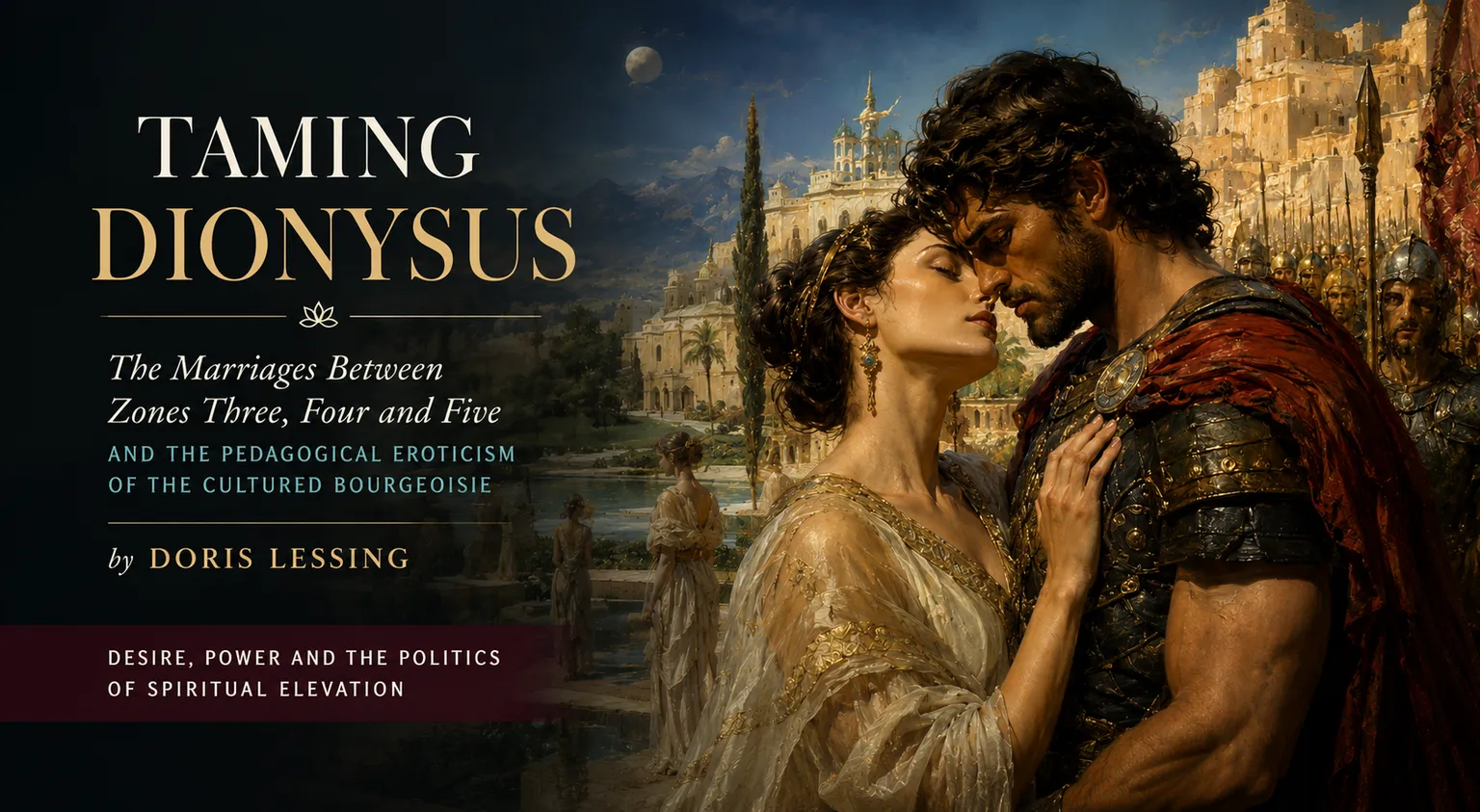
Taming Dionysus
The Marriages Between Zones Three, Four and Five and the Pedagogical Eroticism of the Cultured Bourgeoisie
Among Doris Lessing's most unusual and difficult-to-classify novels, The Marriages Between Zones Three, Four and Five occupies a peculiar position — one that rewards closer scrutiny than it typically receives. Part of the Canopus in Argos cycle, the novel presents itself as a political and spiritual allegory about the encounter between incompatible civilizations: the refined and harmonious Zone Three is forced into union with the militarized and patriarchal Zone Four through the arranged marriage between Queen Al·Ith and the ruler Ben Ata.
As often happens in Lessing's fiction, the clash between worlds becomes a confrontation between psychological, cultural, and erotic models. Desire emerges from difference itself — from the collision between order and brutality, discipline and instinct, refinement and barbarism.
Many readings of the novel have emphasized its openness toward contamination and the overcoming of rigid identities. Yet a closer look at its emotional structure reveals something quite different: the novel seems ultimately unable to embrace the truly destabilizing dimension of desire. The eroticism Lessing imagines does not dissolve the self, does not produce loss of control, and never opens onto collective chaos or passionate degradation. Instead, desire is repeatedly transformed into a pedagogical and spiritual experience. Beneath the novel's progressive surface lies a deeply bourgeois and elitist vision of erotic life.
Desire as Fascination with the Barbaric
The relationship between Al·Ith and Ben Ata is built around a tension deeply embedded in the modern imagination: the fascination of refined civilization with an energy perceived as more primitive, virile, and authentic.
Zone Three is an almost rarefied world. Its inhabitants appear harmonious and contemplative, capable of controlling their emotions and impulses — an aestheticized society in which conflict has been neutralized through ritual, sensitivity, and cultivated distance.
Ben Ata enters this fragile equilibrium as an embodiment of force and corporeality. He is direct, hierarchical, impulsive. In him converges a fantasy that runs through much of European bourgeois culture: the desire for the "barbaric" as a means of regenerating an exhausted civilization.
Yet Lessing never truly allows this energy to become subversive. Ben Ata may disturb Al·Ith's world, but he cannot destroy it. The protagonist constantly retains an implicit superiority — greater balance, greater lucidity, a wider consciousness. The barbaric male is desired, but only within carefully controlled limits. He is not an autonomous force; he is an energy to be absorbed, educated, and transformed.
An Eroticism Without Degradation
It is here that the novel reveals its deepest ambiguity.
Lessing's erotic experience continuously evokes the risk of transformation while systematically avoiding its most destabilizing consequences. Desire never leads to a genuine loss of self. It never produces obsession, dependency, humiliation, or emotional collapse.
This becomes especially clear with the introduction of the woman from Zone Five. In a narrative genuinely interested in the concrete implications of desire, such a situation would inevitably generate jealousy, rivalry, fear of replacement — profoundly human emotions that resist easy sublimation.
But in The Marriages Between Zones Three, Four and Five, erotic conflict is quickly transformed into spiritual growth. Al·Ith never descends into affective competition. She never loses control of herself. Her symbolic identity is never truly shattered. The crisis is absorbed and transfigured. Desire does not open a wound; it produces maturation.
Lessing's Pedagogical Eroticism
At this point the novel can no longer be read simply as a celebration of desire. It becomes an attempt to discipline it.
Lessing's eroticism is profoundly Apollonian. It does not seek the dissolution of boundaries but their harmonious integration. If the Dionysian — in the sense proposed by Nietzsche — implies chaos, collective contagion, and the collapse of hierarchies, Lessing's world moves in precisely the opposite direction: transforming desire into an instrument of higher consciousness.
Erotic maturity becomes the ability to pass through conflict without being consumed by it. Transcendence becomes synonymous with self-control.
This vision inevitably produces a hierarchical structure. Not everyone is capable of experiencing desire "correctly." There are more mature individuals, more evolved forms of consciousness, spiritually superior societies. Zone Three thus takes on the appearance of an aristocracy of sensibility: a world of refined subjects capable of sublimating chaos instead of being overwhelmed by it.
Sufism and the Spiritualization of Desire
Naturally, this critical reading cannot ignore the spiritual context in which Doris Lessing wrote the novel. During the 1970s, Lessing became deeply interested in Sufism, particularly through the teachings of Idries Shah. Much of the Canopus in Argos cycle reflects a conception of the evolution of consciousness strongly shaped by that influence.
From this perspective, possessiveness is regarded as a lower form of consciousness, jealousy as an attachment of the ego, desire as an energy to be transformed rather than expressed.
Al·Ith’s trajectory toward detachment and inner maturation therefore acquires a clearly initiatory meaning.
Yet this does not dissolve the critical problem; it merely shifts it onto another level.
The issue is not whether Lessing “correctly understood” Sufism, but rather how certain forms of Eastern or quasi-Eastern spirituality were reinterpreted within late twentieth-century Western intellectual culture. In the novel, transcendence tends to coincide with ideals of self-control, emotional balance, and refinement of sensibility that are highly compatible with the ethics of the educated European bourgeoisie.
Eroticism is not liberated but disciplined. Conflict is not pushed to the point of self-destruction but transformed into an opportunity for inner growth. Spirituality ultimately functions as a mechanism for neutralizing excess.
Rather than opening itself fully to Dionysian chaos, the Sufism reimagined by Lessing seems to offer the cultivated Western subject a sophisticated technique for coexisting with desire without ever being overwhelmed by it.
Canopus and the Hierarchy of Consciousness
The presence of Canopus reinforces this ideological structure further.
The cosmic entity directing the evolution of the Zones functions as a superior pedagogical elite. Historical and emotional transformations do not emerge spontaneously from below but are guided by an advanced intelligence shaping the destiny of lesser civilizations.
The novel thereby replaces traditional economic hierarchy with a spiritual hierarchy of consciousness. Some subjects understand; others remain trapped within ego and brutality. Some can transcend conflict; others are dominated by it. Liberation does not appear as a collective and universal possibility but as the privilege of individuals refined enough to transform desire into spiritual elevation.
Conclusion
The Marriages Between Zones Three, Four and Five presents itself as a novel of contamination and reciprocal transformation. Yet beneath this promise of openness lies a profound distrust toward everything in desire that might become genuinely destabilizing. The barbaric is invoked but never truly allowed to erupt. Jealousy is rapidly sublimated. Erotic rivalry becomes spiritual detachment. The refined subject passes through chaos without ever truly disintegrating.
The eroticism Lessing imagines is therefore not Dionysian liberation but pedagogical emancipation. It does not abolish hierarchies; it redefines them in spiritual terms. And in this sense, the novel ultimately embodies one of the most sophisticated expressions of the progressive bourgeois imagination of the late twentieth century: fascinated by alterity, seduced by barbaric vitality, yet incapable of fully accepting its destructive force.
The result is a novel that appears to flirt constantly with Dionysus while working relentlessly to tame him.