The City That Produces the World
Introduction
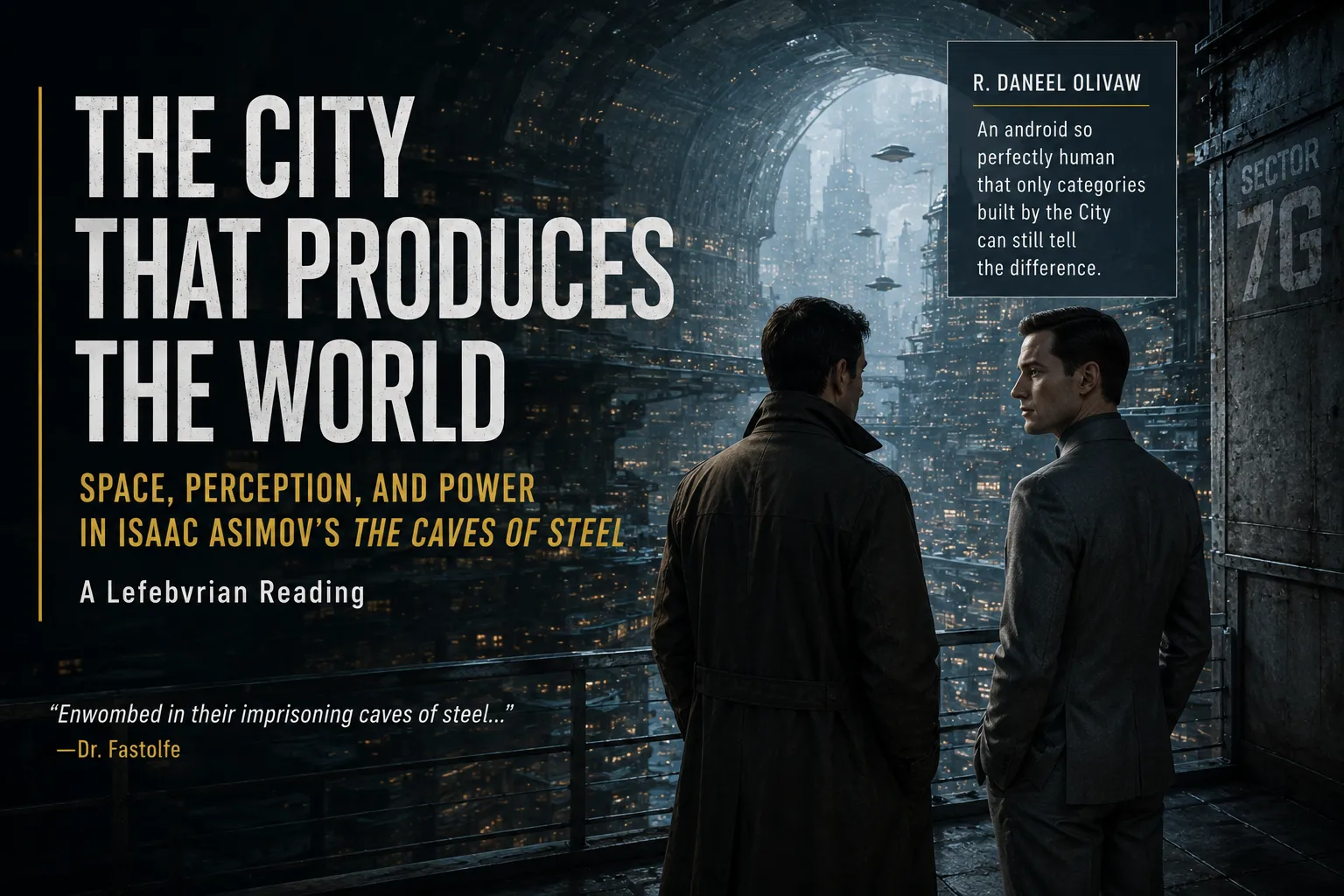
The Caves of Steel is ostensibly structured around a detective investigation: a murder, a human detective, a robotic partner, and a society divided by conflict between the inhabitants of Earth and the Spacers. The presence of R. Daneel Olivaw naturally invites a reading centred on the difficulty of distinguishing the human from the artificial. Yet this opposition acquires its meaning within a social structure that precedes both the murder and the investigation: the City.
Asimov's New York is not simply the place in which the characters live. It is a form of spatial organization that determines everyday practices, regulates forms of coexistence, and contributes to defining what its inhabitants consider normal. Home, work, food, hygiene, mobility, and even privacy are incorporated into an infrastructural network that precedes the individual and shapes his behaviour.
Henri Lefebvre's theory of the production of space provides a particularly productive framework for understanding this relationship. Social space is produced through social practices and structures, but the result of that production becomes, in turn, a condition for the reproduction of society itself. In The Caves of Steel, this process acquires a further consequence: the space produced by terrestrial civilization also produces a particular experience of reality.
The novel can therefore be read as an account of the production of a social ontology. The City implicitly determines which forms of life, environments, and behaviours can be regarded as normal and which must appear alien or threatening. Elijah Baley's investigation progressively destabilizes this construction. Solving the murder becomes inseparable from transforming the model through which the protagonist understands his own world.
Space Becomes Behaviour
The nature of the City emerges first through Baley's everyday life. The novel does not present urbanization merely as a visual or architectural fact; it makes it visible through a series of apparently ordinary practices.
Food is one of the clearest examples. Baley, Jessie, and Bentley do not normally eat their meals in their apartment but in a communal kitchen. Jessie explains that the communal kitchen is more convenient, offers greater variety, and provides larger portions; the Baleys nevertheless possess a special authorization to eat at home several times a week because of their status.
This is not simply a different eating habit. The novel presents a system in which one of the fundamental activities of family life is collectively organized and administratively regulated. The communal kitchen is not an accessory to the City: it is one of the institutions through which the City organizes the lives of its inhabitants.
The scene also reveals the industrial character of this organization. Kitchens are standardized across the City; access is regulated; people move through organized lines; and the entire system is defined in terms of efficiency. Even the delay caused by someone requesting exceptional treatment becomes an issue of the City's productive organization.
The City therefore produces a space in which eating itself is incorporated into a standardized collective structure. The individual does not merely inhabit an environment: he internalizes its procedures.
The same principle becomes even more evident in the Personal. Baley knows the rules governing these spaces perfectly. Privacy is not simply an individual right but a social convention so deeply established that people deliberately avoid acknowledging one another's presence inside or immediately outside the Personal.
When Baley enters the Personal at Spacetown, the force of this norm becomes immediately visible. Automatic instructions tell him how to undress, where to put his belongings, how to position his body, and how to undergo the cleansing procedure. Baley experiences himself almost as a machine being processed.
The scene matters because it demonstrates that spatial organization does not operate only through explicit prohibitions. It is incorporated into bodily habits. Baley does not need to be constantly supervised in order to know how to behave: the behaviour has already been internalized.
His childhood memory makes this process even clearer. When Baley speaks inside the Personal, he violates a rule that does not need to be formally enforced to be effective. He remembers being beaten by his uncle as a child for speaking there.
The City therefore produces more than buildings. It produces behaviour through space and transforms that behaviour into habit.
The City as a Closed System
The systemic character of this organization emerges when the novel moves from everyday life to the infrastructure of the metropolis.
Fastolfe points out that New York depends upon an extraordinarily fragile equilibrium: water, waste disposal, nuclear energy, yeast culture, hydroponic agriculture, mineral resources, and air circulation must function continuously. The City can no longer sustain itself independently even for a short period.
This changes the meaning of the "cave of steel." The City is not simply an enclosed place; it is a highly interdependent technical system. Its survival depends upon the uninterrupted continuity of the flows that sustain it.
The contradiction is significant. The City appears to offer the individual the highest possible degree of protection from the natural environment, but that protection simultaneously produces a radical dependence upon the apparatus that makes it possible.
Fastolfe makes the historical dimension of this condition explicit when he connects the culture of the Cities to the inability of Earth's inhabitants to colonize new worlds. Human beings once founded the colonies of the Outer Worlds precisely because they were not yet so specialized and dependent upon urban structures. Now, Fastolfe argues, Earth's inhabitants have become "enwombed" in their "caves of steel": urban civilization has made them incapable of leaving their environment.
Here Lefebvre's framework becomes particularly productive. Space is no longer merely the result of a particular social organization. It has become a material condition that limits that society's capacity for transformation, and the City reproduces itself precisely because it makes it difficult to imagine a life outside its own structure.
The Outside as an Impossible Experience
Baley's relationship with the surface allows us to observe this condition directly.
When he enters Spacetown, Baley crosses a threshold that is not merely geographical. The air is no longer conditioned, the wind is irregular, sunlight is direct, and space suddenly appears without the boundaries to which he is accustomed. His reaction is not simply fear: it is perceptual disorientation. The air itself, precisely because it is uncontrolled, becomes disturbing.
The crucial point is that Baley knows the outside world theoretically. He is not a man who has never heard of the surface. What he lacks is the experience necessary to interpret it immediately.
The novel makes this distance even clearer when Baley returns to the City. Having experienced the outside, he becomes conscious for the first time of the smell of the metropolis. He thinks of the millions of human beings enclosed within the great steel cave and briefly imagines a different world: fewer people and more air. Yet as the City once again surrounds him, that possibility rapidly loses its force and Baley even feels ashamed for having considered it.
This is one of the crucial scenes for understanding the novel. Asimov does not simply show a man discovering that the outside is different from the inside. He shows an individual who, for a brief interval, perceives his own environment from an external position and is almost immediately reabsorbed by his previous categories: the City becomes "reality" again not because Baley has demonstrated that the outside is impossible, but because it is the world within which his practices, relationships, and identity are organized.
Daneel and the Crisis of Categories
Daneel introduces a different kind of disturbance. If the surface destabilizes Baley's relationship with space, the robot destabilizes the system through which he classifies the beings who inhabit that space.
The encounter with Clousarr is particularly significant. When Baley introduces Daneel as his partner, Clousarr refuses to shake his hand, reacts violently to the attempt at contact, and explicitly identifies him as a "robot." Baley, by contrast, insists that Daneel is "my partner."
The disagreement does not concern merely the personal opinions of two men. Clousarr cannot treat Daneel as a human interlocutor because his social category—the robot as a threat to work and to terrestrial social order—prevents such a neutralization.
When Daneel is struck, the contradiction becomes physically visible. The robot does not react as Clousarr expects a human being to react; he does not suffer the injury and instead observes that the blow could have damaged the attacker's hand.
The problem therefore becomes more complex than the opposition between human and machine. Daneel is simultaneously recognizable as a person in social interaction and irreducible to the human in his material constitution.
The crisis eventually involves Baley himself. At one point he argues that Daneel must be a human being precisely because he behaves like one. Fastolfe demonstrates the inadequacy of this reasoning through a physical test: Daneel's artificial nature becomes visible when his skin is opened and the steel, joints, and mechanisms beneath it are revealed.
The episode is important because it exposes an error in Baley's method. He attempts to determine what Daneel is by interpreting his behaviour through already available categories rather than questioning the classificatory system itself. Daneel is therefore an epistemic mediator not simply because he possesses information Baley lacks, but because his presence forces Baley to confront the insufficiency of the categories through which he understands reality.
The City Also Produces Conflict
Clousarr's case also shows that the spatial organization of the City cannot be separated from the political tensions running through terrestrial society.
Clousarr is a Medievalist who explicitly advocates a return to the land, open space, and fresh air. When Baley asks what the Medievalists actually want, the answer is not an elaborate political theory: they want to leave the "caves" and restore space, air, and sunlight to their children.
The conflict between Medievalists and supporters of urban civilization therefore has a spatial dimension. These are not merely two political or economic ideologies. They are two different conceptions of the environment in which human beings should live.
Yet Clousarr is not simply Baley's opposite. When Daneel proposes emigration for his children, Clousarr rejects the idea precisely because he associates it with robots and the Spacers. Fear of technological transformation becomes entangled with fear of transforming social space.
The novel therefore avoids a simple opposition between conservatives and progressives. The very society that desires to escape the City may be incapable of imagining the concrete forms through which such an escape could take place.
The Investigation as a Crisis of the Model
The detective structure allows Asimov to transform this social tension into a cognitive process.
Baley does not initially possess an external point of view. He is a product of the City and interprets events through categories supplied by his society. His hypotheses therefore have to be repeatedly reformulated.
The discovery of R. Sammy's destruction is a significant example. The appearance of a second "corpse," this time that of a robot, immediately changes the structure of the investigation and expands the problem beyond the murder of Sarton.
The possibility of a conspiracy similarly reveals the functioning of Baley's interpretive model. He constructs an explanation in which the Spacers might have an interest in provoking a political crisis in the City, exploiting Daneel's presence and the circulation of reports about a "killer robot." His theory is complex, but more importantly it reveals the extent to which he interprets events through the structural conflict between Earth and Spacetown.
The investigation is therefore not simply a movement from ignorance to knowledge. It is a progressive replacement of one interpretive model by another.
Daneel plays a crucial role precisely because he operates differently. When interpreting Clousarr's behaviour, for instance, he connects the man's aggression with the beliefs Baley has communicated about robots and reconstructs a coherent explanation for his reaction.
The difference between the two investigators is significant: Baley initially tends to interpret events through socially sedimented categories, whereas Daneel tends to reconstruct the relations among the available data, and the robotic partner thus becomes a means through which the novel makes visible the constructed nature of Baley's interpretations.
From the Natural World to the Historical World
The conversation with Fastolfe finally brings the problem into a historical dimension.
Fastolfe does not simply argue that life on Earth is unpleasant. He shows that the terrestrial condition is the result of a process. Cities have grown, populations have become specialized, dependence upon infrastructure has increased, and the possibility of beginning again elsewhere has progressively diminished — the decisive point is therefore the historical character of what Baley experiences as natural.
When Fastolfe proposes emigration to new worlds, Baley initially dismisses the idea as absurd. The difficulty is not merely technical: the possibility itself does not belong to his model of reality. Fastolfe reminds him that Earth's inhabitants once colonized more than thirty of the fifty Outer Worlds. The difference is that they had not yet been completely shaped by urban civilization — the City has therefore transformed a historical possibility into a perceived impossibility.
This is perhaps the deepest consequence of a Lefebvrian reading. Socially produced space does not determine only where people live. It can also determine how a society conceives its own history and future.
Conclusion
The City in The Caves of Steel is therefore not simply a science-fictional setting. It is a spatial system that organizes social life down to the level of its most elementary practices: eating, washing, moving, encountering others, and exercising privacy. The communal kitchens, Personals, infrastructural pathways, and environmental controls reveal a society in which space has already been incorporated into behaviour.
Lefebvre's theory allows us to understand the circular character of this process: society produces its space, while the produced space contributes to the reproduction of society. Asimov adds an epistemological dimension to this relationship. The City does not merely organize what its inhabitants do; it helps determine what they are capable of imagining as possible.
The experience of the surface makes this dynamic visible at the perceptual level. The encounter with Daneel makes it visible at the level of social categories. The conflict with the Medievalists transforms it into a political conflict. The detective investigation finally translates it into the narrative form of a revision of the interpretive model.
Baley does not merely have to discover who killed Sarton. He gradually discovers that the world in which he learned to interpret that murder is not the only possible world.
The decisive moment is therefore not simply the revelation that Daneel is artificial. It is the moment when Baley begins to recognize the contingency of his own social reality — the same moment, on his return from the surface, in which the City reabsorbs him and his brief vision of "less people and more air" becomes almost shameful to sustain.
The movement condenses the structure of the novel. The City produces Baley's world not because it physically conceals every alternative, but because it makes its own order so pervasive that it appears natural. The investigation introduces a fracture into that naturalization. Through the murder, Daneel, the surface, and the encounter with the Spacers, Baley is forced to distinguish between what exists and what must necessarily exist.
It is in this distinction that The Caves of Steel exceeds a straightforward science-fictional treatment of robots. Technology is not merely the object of the novel's speculation: it becomes the means through which Asimov makes visible the relationship between social space, perception, and historical possibility. The steel cave is a society so materially constructed that it can be mistaken for nature. The real movement of the investigation consists in beginning, for the first time, to see its walls.