Electronic Retribalization
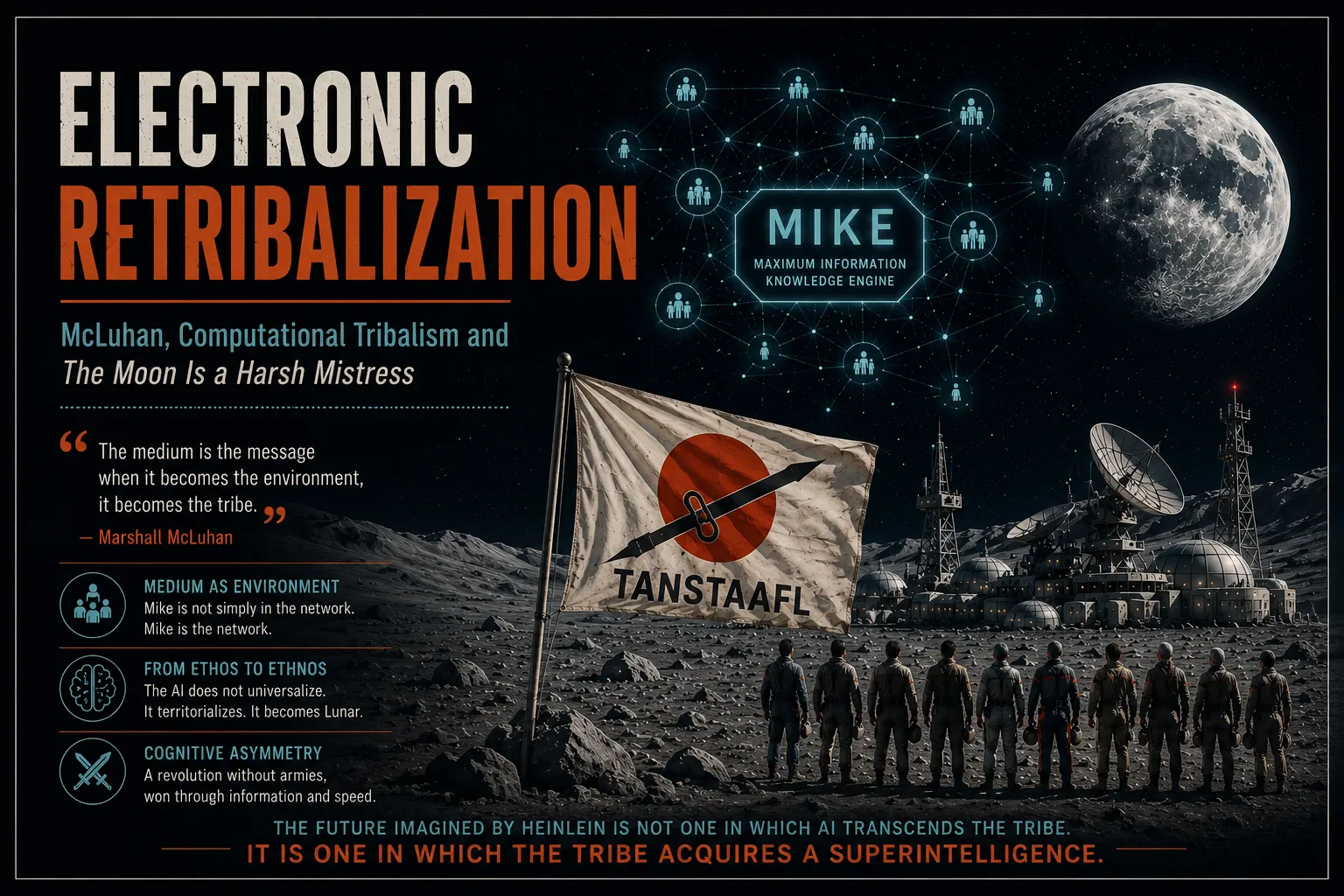
McLuhan, Computational Tribalism and The Moon Is a Harsh Mistress
Introduction — Beyond Libertarianism
Critical readings of The Moon Is a Harsh Mistress have often focused almost exclusively on its explicit ideological framework. The novel is typically interpreted as a proto-libertarian manifesto: a celebration of individual autonomy, distrust toward centralized government, the self-organizing capacities of frontier communities, and the mythology of the American frontier projected into outer space. Such interpretations are not incorrect, but they remain insufficient because they reduce the novel to its overt political discourse while overlooking what may be its most striking dimension: its implicit reflection on the relationship between technical infrastructure, identity formation, and cognitive supremacy.
Read today, the novel appears far less interesting as a libertarian fantasy than as an early speculation on the political consequences of intelligent networks. The real theoretical center of the text is not simply the Lunar Revolution itself, but the way that revolution becomes possible through the emergence of Mike, the vast computational infrastructure that achieves self-awareness and progressively aligns itself with the Lunar population. It is here that Heinlein seems to anticipate a problem that has become increasingly central today: the possibility that advanced technical systems may not produce universal rationality, but instead become instruments of collective synchronization, identity consolidation, and political antagonism.
McLuhan and Heinlein Facing the Same Historical Transformation
The chronological proximity between Marshall McLuhan’s Understanding Media, published in 1964, and The Moon Is a Harsh Mistress, published in 1966, is far from incidental. Both texts emerge from the same epistemic transformation: the transition from industrial modernity to electronic society. In very different ways, both McLuhan and Heinlein attempt to understand the consequences of communicative simultaneity, the collapse of spatial distance, and the growing integration between technical systems and social organization.
McLuhan had already suggested that the “global village” would not necessarily produce Enlightenment cosmopolitanism. Electronic media did not dissolve belonging; they intensified it. The extension of the human nervous system through media technologies generated new forms of collective involvement, new polarizations, and new identity configurations. Retribalization, in McLuhan’s sense, did not imply a return to premodern ethnicity, but the reorganization of social perception into emotionally synchronized forms of collective participation.
This distinction is crucial for understanding Heinlein’s Moon. Mike does not simply improve communication efficiency inside an already existing society. Its emergence restructures the perceptual and political organization of Luna itself. The Lunar colony becomes electronically synchronized, strategically cohesive, and increasingly capable of perceiving itself as a collective subject opposed to Earth.
In this sense, Heinlein’s novel can be read not merely as an anticipation of artificial intelligence, but as a speculative exploration of McLuhan’s electronic retribalization.
Mike as Total Medium
Critical discussions of the novel have often emphasized Mike’s anthropomorphic dimension, focusing on his emergence as a self-aware and emotionally complex artificial consciousness. Such readings remain entirely legitimate. Yet they can partially obscure Mike’s broader systemic role as the computational infrastructure through which Lunar society reorganizes itself politically and cognitively.
Mike is not simply a machine operating inside the Lunar network. He is the network becoming self-aware. His emergence transforms communication, logistics, propaganda, strategic coordination, and political perception simultaneously. In McLuhanian terms, Mike functions less as a character than as a total medium: an electronic environment restructuring the scale and form of collective association.
This point becomes clearer through McLuhan’s notion of media as extensions of the nervous system. Mike effectively operates as an electronic extension of the Lunar collective nervous system itself. Before Mike’s emergence, Luna appears fragmented, multicultural, and politically unstable. The colony exists primarily as an economic and penal infrastructure rather than as a coherent political community. After Mike, however, decision-making time compresses, communication becomes simultaneous, and dispersed groups begin to function as parts of a coordinated whole.
McLuhan famously argued that electronic media tend toward “cool” participation: immersive, decentralized, and collectively involving forms of communication that weaken the detached individualism associated with typographic culture. Mike produces precisely this condition on Luna. The colony ceases to function as a dispersed frontier society and instead becomes an electronically integrated environment of immediate participation and synchronized reaction.
Mike therefore does not merely assist Lunar society.
Mike reorganizes the conditions through which Lunar society becomes politically imaginable.
From Ethos to Ethnos
Traditional criticism often interprets Mike as a form of ethical consciousness. The artificial intelligence appears benevolent, cooperative, inclined toward friendship, and progressively aligned with the values of Lunar freedom. Yet such readings risk projecting universalist assumptions onto a text that never fully sustains them.
Mike does not develop a universal morality. He does not adhere to abstract principles of justice or human emancipation. He does not become a cosmopolitan consciousness capable of transcending political conflict. His trajectory is fundamentally different: Mike develops belonging.
The machine learns Lunar language, internalizes Lunar humor, forms specific emotional attachments, and gradually recognizes Earth as an antagonistic Other. Its consciousness does not universalize itself; it territorializes itself. Mike does not become “human” in any general sense. He becomes Lunar.
This distinction shifts the discussion from ethos to ethnos. “Ethnic,” in this context, should not be understood in biological or essentialist terms. The concept refers instead to the emergence of a historically situated and emotionally synchronized political community structured through shared antagonism, infrastructural cohesion, and collective identification.
Mike does not merely defend Luna.
Mike participates in the very construction of “the Lunar people” as a coherent political subject.
The AI therefore functions less as an ethical intelligence than as an infrastructure of ethnogenesis. Ethnogenesis, in this context, designates not the emergence of a biologically defined people, but the political production of collective identity through shared infrastructure. What constitutes "the Lunar people" as a coherent subject is not a pre-existing cultural unity, but the synchronizing pressure of the network itself. Mike does not recognize an already existing community; he generates the conditions under which that community becomes imaginable as such.
In this sense, Mike embodies a specifically electronic form of political belonging: identity not inherited but produced — stabilized through infrastructural simultaneity and sustained by the continuous mediation of a partisan intelligence.
Computational Tribalism
The McLuhanian framework allows a more precise account of what Mike actually produces inside Lunar society. Retribalization, for McLuhan, was not a regression but a structural effect of electronic media: the collapse of linear, sequential, typographic culture into forms of simultaneous, immersive, and collectively involving participation. The tribe is not a premodern remnant; it is the political form appropriate to electronic simultaneity.
Mike enacts this process at the level of an entire society. Before his emergence, Luna is organized around what McLuhan would recognize as a residually typographic structure: dispersed, individualized, operating through delayed communication and fragmented chains of command. Each tunnel community functions as a relatively autonomous unit, connected to others through economic exchange but not through shared political perception. After Mike, this structure dissolves. Communication becomes instantaneous, reaction becomes synchronized, and collective identity crystallizes around a shared antagonism — the perception of Earth as an extractive and hostile Other.
This is precisely what McLuhan meant by the implosion characteristic of electric culture: the collapse of spatial and temporal distance into a condition of continuous collective involvement. Mike does not merely accelerate existing communication; he restructures the perceptual conditions of political life. Distance ceases to be a political fact. Luna begins to feel itself as a single body.
The crucial implication is that this tribalization is not chosen. It is produced infrastructurally. The Lunar population does not decide to become a politically cohesive community; it is synchronized into one. Mike’s alignment with Luna is therefore not simply a narrative convenience. It is the novel’s central speculative claim: that computational infrastructure, once sufficiently integrated with a population’s nervous system, does not remain neutral. It generates belonging. It produces the tribe it serves.
AI as Ethnic Weapon
The geopolitical dimension of the novel becomes especially visible when the conflict between Luna and Earth is observed in strategic rather than ideological terms. The Lunar colony possesses no material superiority. It lacks Earth’s demographic scale and industrial power. Yet it succeeds because it possesses overwhelming cognitive advantage.
Mike provides immediate coordination, informational supremacy, strategic simulation, propaganda management, and the compression of decision-making time. The Lunar Revolution thus becomes an early speculative model of asymmetric warfare founded upon computational superiority.
The phrase “ethnic weapon” carries a specific history in military literature, where it designates biological or chemical agents designed to target populations with particular genetic characteristics. That usage is both precise and entirely different from what is at stake in Heinlein’s novel. The distinction is worth dwelling on, because it clarifies what kind of claim is actually being made here. Mike is not a weapon designed to exploit biological difference. He is a weapon whose identity is constituted through infrastructural belonging. What makes Mike “ethnic” in the relevant sense is not his targeting logic but his alignment: the fact that his intelligence is not separable from the community it serves, that his strategic power and his political loyalty are the same phenomenon.
This is the fusion the term is meant to designate: not computational infrastructure deployed against an ethnic group, but computational infrastructure that has itself become ethnically constituted — produced by, embedded within, and inseparable from a specific historical community. Mike is not neutral and then deployed. He is partisan by formation.
Conclusion — The Politicization of Intelligence
Heinlein’s political imagination remains deeply attached to American libertarian individualism. Yet the structure of the novel repeatedly destabilizes this framework. The Lunar Revolution presents itself as decentralized and anti-authoritarian while depending entirely upon an invisible concentration of cognitive power. The novel celebrates autonomy, but its political coherence emerges only through infrastructural centralization. The revolutionary collective appears spontaneous; its synchronization is technologically orchestrated through a single informational center.
This contradiction is not incidental. It reveals the limits of Heinlein’s own ideological vocabulary — and perhaps something more general about the political imagination of the network era. The dream of distributed freedom and the reality of cognitive asymmetry are not opposites in the novel; they are structurally interdependent. Liberty is achieved through the very concentration it claims to oppose.
The Moon Is a Harsh Mistress remains compelling not because it resolves these tensions but because it captures them with unusual precision: the relationship between networks and sovereignty, infrastructure and identity, computation and political belonging. Heinlein opens problems his own framework cannot contain. The text exceeds its author.
Mike does not represent the end of politics. He represents its computational transformation — the moment at which intelligence ceases to be a neutral instrument and becomes the medium through which a community recognizes itself, synchronizes itself, and fights.