The Drowned World: A Heart of Darkness for the Nuclear Age
Introduction
There are novels that attempt to imagine the future and novels that attempt to imagine the end of the future itself.
The distinction may appear subtle, but it separates much of post-war science fiction from the peculiar trajectory followed by J.G. Ballard during the 1960s. The dominant narratives of the period remained deeply attached to the idea that history, however catastrophic its interruptions, retained a direction. Even the nuclear imagination of the Cold War preserved this assumption. The mushroom cloud represented the violent termination of progress, but it nevertheless belonged to the same historical vocabulary of conflict, ideology and technological power that had produced the modern world in the first place. The Drowned World proposes something entirely different.
Ballard's submerged London is not the result of war, political collapse or technological hubris. More importantly, it is not a world waiting to be rebuilt. The city survives physically while losing the historical framework that once made it intelligible. Streets, hotels and office buildings remain visible beneath the lagoons, yet they increasingly resemble the ruins of forgotten empires rather than the remains of a recent civilization. Read from the perspective of 1962, the originality of the novel lies less in its environmental catastrophe than in its unusual conception of historical decline: Ballard replaces the instantaneous violence of the atomic imagination with a slower and more unsettling process in which civilization gradually ceases to occupy the centre of the world it had created. In doing so, The Drowned World moves away from the tradition of apocalypse and enters a much older literary territory — the literature of ruins, imperial decline and civilizations confronting their own mortality.
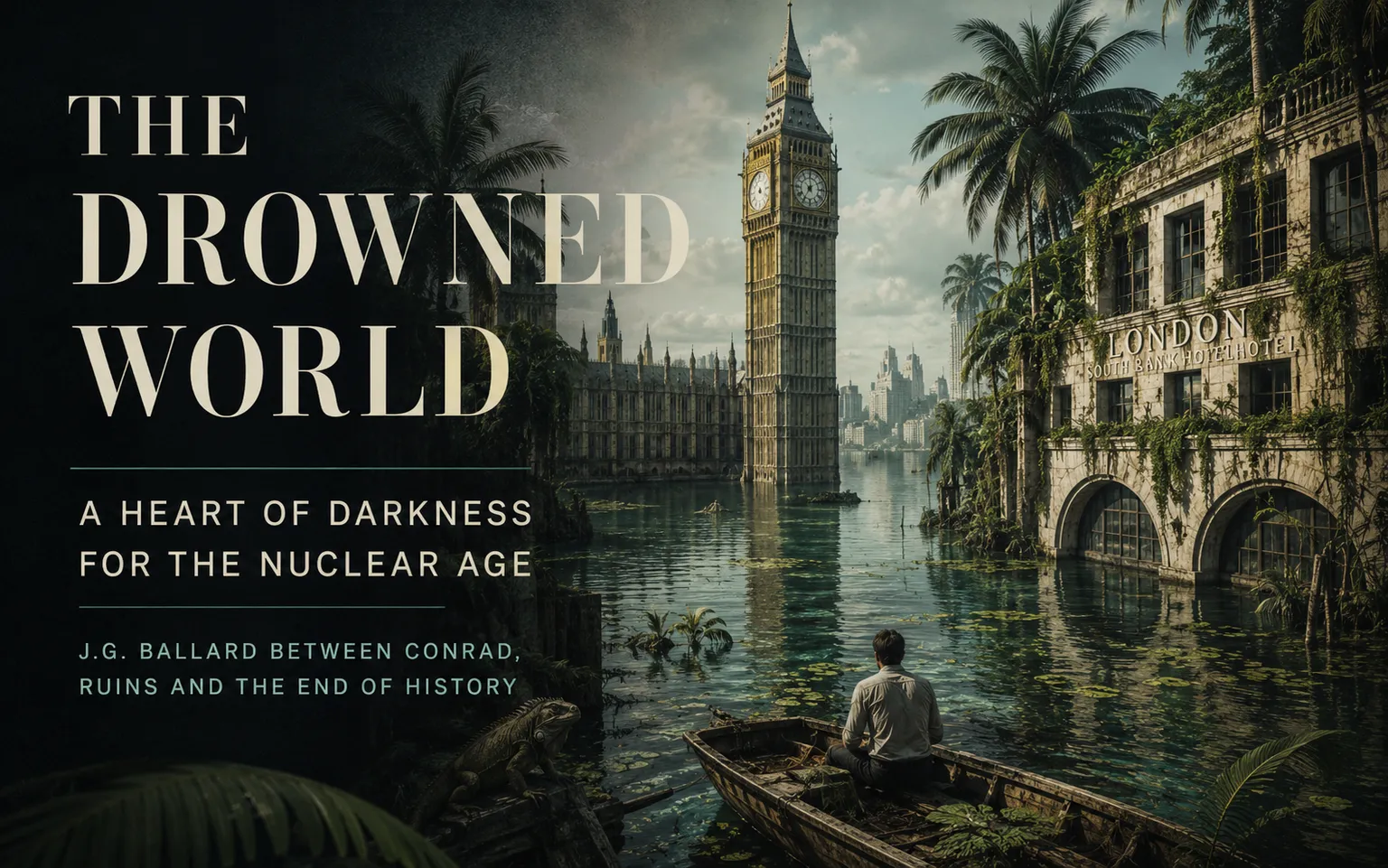
By 1962, the Western imagination had already developed its own iconography of the end of the world. The Cold War had transformed the mushroom cloud into the dominant image of apocalypse, and much of the fiction of the period imagined the collapse of civilization as a sudden, violent and irreversible event. Destruction arrived from above in the form of nuclear war, technological catastrophe or total military annihilation. It is precisely within this context that J.G. Ballard published The Drowned World. The novel shares with post-apocalyptic fiction of the period an awareness of the fragility of industrial civilization, yet it rejects entirely the imagery through which that fragility was usually represented. London is not erased by bombardment, nor does Ballard offer the radioactive wasteland that dominated so much science fiction of the 1950s. When Robert Kerans moves through the city, the buildings remain standing, the towers still emerge from the tropical lagoons, and the urban geometry survives beneath the water almost intact.
What has disappeared is not the city itself but the historical function of the city. Ballard repeatedly insists upon this peculiar form of survival. Luxury hotels have become artificial islands surrounded by vegetation, administrative buildings have been colonized by iguanas and alligators, while streets and public squares continue to exist despite no longer belonging to the human world. London appears less like a destroyed city than like an archaeological site left behind by a vanished civilization — the originality of the novel residing precisely in this substitution of catastrophe with archaeology, in Ballard's decision to imagine the end of modernity not as an explosion but as sedimentation.
Water Against History
The choice of water as the dominant element of the novel is not merely a matter of setting. It determines the very way in which civilization disappears. Fire and explosions destroy through separation: buildings collapse, cities are reduced to rubble, and landscapes bear visible traces of the violence that has transformed them. Water operates according to an entirely different logic.
Throughout the novel London is not demolished but gradually incorporated into a different ecosystem. Buildings survive as artificial reefs, streets become canals, and public spaces turn into underwater environments inhabited by tropical fish and reptiles. The decisive transformation is therefore not the physical destruction of urban forms but the disappearance of the distinctions that had once given those forms their meaning. The separation between city and nature ceases to be self-evident; the distinction between the artificial and the organic becomes increasingly unstable; even the boundary separating historical time from deep prehistory begins to dissolve.
This process becomes particularly visible in the relationship that the protagonists develop with the landscape surrounding them. Kerans and the members of the scientific expedition do not behave like survivors attempting to reconstruct the lost world. The oppressive heat, the slowing of biological rhythms and the recurrence of prehistoric dreams gradually erode any desire to restore the previous order. Water does not wage war against civilization — it merely renders it irrelevant.
Geological Time and the Contemporary Ruin
One of the most remarkable aspects of The Drowned World lies in the temporality it introduces. Western modernity is founded upon a linear conception of history in which the future represents the privileged site of progress and technological development. Classical science fiction inherited this model and transformed it into narratives of expansion toward new worlds and new possibilities. Ballard replaces historical time with geological time.
The most important transformation in the novel is not the geographical shift of climatic zones but the re-emergence of a past that precedes humanity itself. Kerans's dreams are populated by gigantic suns, Carboniferous forests and primordial lagoons — visions that do not resemble nostalgia for an individual past but rather the activation of a biological memory belonging to the species as a whole. The movement southward therefore acquires a meaning that extends far beyond geography: each mile travelled toward the equator corresponds to a movement backwards through evolutionary time, and The Drowned World comes to represent not the future of humanity but the return of a past infinitely older than humanity itself.
This transformation of history into geology radically alters the significance of the ruined city. Walter Benjamin, writing of the ruin as the emblem of history understood not as progress but as catastrophe and accumulation, provides a framework for understanding what Ballard achieves here. For Benjamin, the ruin does not mark the failure of a civilization to endure; it reveals the truth that every monument of culture has always contained within itself the conditions of its own dissolution. The flooded towers of London operate according to exactly this logic: they do not mourn a lost world but make visible what that world always was — a temporary arrangement of forces that geological time was never obliged to preserve. London no longer appears as the capital of a declining empire but as a dead city belonging to the same temporal order as Pompeii or Angkor, and Western civilization suddenly discovers itself occupying the same position that it had long assigned to the civilizations of antiquity.
Conrad After Hiroshima
The text that perhaps illuminates this narrative structure most effectively belongs not to science fiction but to the tradition inaugurated by Joseph Conrad's Heart of Darkness.
In Conrad's novella, the journey along the Congo River coincides with the gradual collapse of the cultural categories through which Marlow interprets the colonial experience. The further he travels from Europe, the less stable the moral and political certainties of empire become. The jungle does not refute European civilization through argument — it simply demonstrates that civilization's categories require a particular geography to remain operational, and that beyond a certain threshold, they cease to function. Ballard adopts this structure and radicalizes it.
Kerans's movement southward does not lead beyond industrial civilization but beyond history itself as an organizing principle of experience. The tropical jungle invading London performs a function remarkably similar to that of Conrad's African forest: it does not destroy the human world through violence but slowly absorbs it into a temporal order far older and larger than itself. Yet where Conrad's darkness operates at the boundaries of empire, Ballard's operates at the centre. There is no Congo to travel to in The Drowned World. The dissolution has arrived in London itself, has settled into its streets, has made its home in its administrative buildings. The colonial uncanny that Conrad located at the edges of the known world has migrated to the metropolis — and with it the possibility of return has disappeared entirely.
Ballard's descriptions constantly emphasize this capacity for assimilation. Buildings are enveloped by vegetation, artificial surfaces become habitats for new forms of life, and the distinction between human artefact and natural environment gradually loses its meaning. If Conrad uses the African landscape to challenge the stability of European identity, Ballard uses the tropical landscape to challenge the centrality of humanity itself. For this reason, The Drowned World can perhaps be read as a kind of Heart of Darkness for the nuclear age: the question is no longer what happens to Europe when Europe loses confidence in its own moral authority, but what happens to humanity when humanity ceases to occupy the centre of natural history.
Kerans, Strangman and the Return of Hierarchy
The arrival of Strangman introduces an entirely different dynamic into the novel. Until his appearance, the tropical environment had gradually dissolved the structures of industrial society without replacing them with a recognizable new order. Strangman's entrance marks the return of categories that had apparently vanished beneath the water: ownership, hierarchy, domination and spectacle.
His obsession with draining the submerged districts of London possesses an unmistakable symbolic significance. To drain the city is, above all, to recreate distinctions. Water had transformed London into a continuous space in which the natural and the artificial, the present and the past, monuments and seabeds had become increasingly indistinguishable. Strangman's operation resembles less an act of salvage than an act of re-inscription: the recovery of property lines, of surfaces that can be owned, of a topography legible to systems of exchange. The fact that his expedition is motivated largely by the recovery of works of art and valuable objects reinforces this interpretation. Benjamin's observation that every document of civilization is simultaneously a document of barbarism finds here a peculiarly literal staging: the objects Strangman retrieves from the lagoons are at once the highest achievements of the civilization that produced them and the instruments through which he reasserts dominion over a world that had briefly escaped such logic. Culture and plunder arrive together, as they always have.
The central conflict of the novel is therefore not between humanity and nature but between two competing responses to the end of Western history. For Kerans, the flooded city represents the end of human centrality; for Strangman, it represents a reservoir of wealth waiting to be reintegrated into systems of ownership and exchange. Kerans gradually accepts the transformation of the world and abandons any project of restoration; Strangman embodies the persistence of the will to domination even after the world that once legitimized that domination has disappeared.
Twilight Instead of Apocalypse
The extraordinary originality of the novel ultimately resides in the tone with which Ballard observes this process. At the height of the Cold War, the end of civilization was almost always imagined as a political or military tragedy. The Drowned World abandons both horror and nostalgia. The final images of the novel do not show burning cities or defeated armies — they show a man voluntarily moving southward while Western civilization slowly transforms into an archaeological landscape behind him.
Ballard seems to suggest that no civilization possesses any ontological privilege over another and that industrial modernity will eventually occupy the same position once assigned to the ruins of vanished empires. For this reason, The Drowned World does not truly belong to the tradition of apocalypse but to the much older literary tradition of civilizations in decline. Its defining image is not the mushroom cloud but something far quieter and perhaps far more unsettling: a city that continues to preserve its form long after the world has ceased to need it.
Conclusion
Perhaps this explains why The Drowned World continues to feel strangely resistant to the categories through which contemporary readers often approach it. The novel certainly contains a catastrophe, but catastrophe is not its true subject. Its real concern lies in the experience of historical decentring: in the moment when a civilization discovers that it occupies no privileged position in the larger chronology of the planet.
The Conrad comparison, followed to its limit, illuminates something that the novel does not quite announce directly. Marlow returns from the Congo. Whatever damage the journey has done to his categories, he reassembles himself sufficiently to narrate, to sit on the deck of a boat on the Thames, to frame Kurtz as a story with a beginning and an end. The journey into darkness remains, for Conrad, a journey with a return trajectory. Kerans does not return. There is no narrative frame waiting for him in London, no deck on which to compose the experience into retrospect. The structure of Heart of Darkness — darkness as destination, civilization as point of departure and implicit return — is precisely what Ballard dismantles.
This may be the deepest difference between the two works, and the one that most clearly marks the distance between colonial anxiety and something that has no stable name yet. Conrad's novel registers the terror of what lies outside the boundaries of the known world. Ballard's registers something colder: the discovery that the boundaries themselves were temporary, that the world they enclosed was always already on its way to becoming geology, and that the darkness was not located at the edge of the map but distributed uniformly across its entire surface.
In the end, what the tropical lagoons of Ballard's London make visible is less the end of Western civilization than the retrospective revelation that Western civilization was always one ruin among others, waiting for the water to rise.