The Last Witness of Elm Haven: Memory, Horror, and American Mythmaking in Dan Simmons' Summer of Night
Introduction
Any discussion of Dan Simmons' Summer of Night seems destined to begin with a comparison to Stephen King's It. The similarities are obvious: a group of boys confronting a supernatural threat during a summer that marks the end of childhood, a small American town haunted by forces older than its inhabitants, and memory as the mechanism through which events are later reconstructed. The comparison has been developed extensively in critical writing on both novels and need not be rehearsed here. What matters for the present argument is a single structural difference: where King is concerned above all with the persistence of evil within a community, Simmons is concerned with the preservation of memory. Horror functions less as a revelation of corruption than as a mechanism through which an ordinary world becomes worthy of remembrance. The novel's true subject is not evil but memory itself — how it is created, preserved, transmitted, and ultimately transformed into myth.
Elm Haven and the Myth of Small-Town America
One of Simmons' most significant achievements lies in his ability to transform ordinary elements of Midwestern life into components of a national mythology. The bicycles, the cornfields, the river, the condemned school, and the long summer afternoons are not merely details of setting. They constitute a symbolic geography through which the novel reconstructs an America that already appears lost at the moment of its depiction.
The summer of 1960 occupies a privileged position in this construction. It stands at the threshold of immense cultural transformations — before Vietnam, before the counterculture, before suburban expansion and mass media fragmentation. Simmons' Elm Haven is not simply a town located in Illinois. It is a remembered America, rendered with an attention to texture and atmosphere that treats the landscape of childhood as something already in the process of becoming myth.
This is why the novel often feels closer to Ray Bradbury's Dandelion Wine than to contemporary horror fiction. Like Bradbury's Green Town, Elm Haven exists less as a geographical location than as a landscape of memory — a place whose significance derives not from what happens within it but from what it represents in the American imagination. What distinguishes Simmons from Bradbury, however, is that he does not preserve this landscape through nostalgia alone. He subjects it to horror.
Horror as a Machine of Sacralization
The central paradox of Summer of Night is that the supernatural threat ultimately serves to increase the value of the world it threatens. Readers often remember the geography of Elm Haven more vividly than the precise nature of the evil confronting the boys. Old Central School, the rides through town, the cornfields, and the hidden spaces of childhood linger in memory long after the details of the monster have faded. This imbalance is not a weakness of the novel. It is one of its defining structural features.
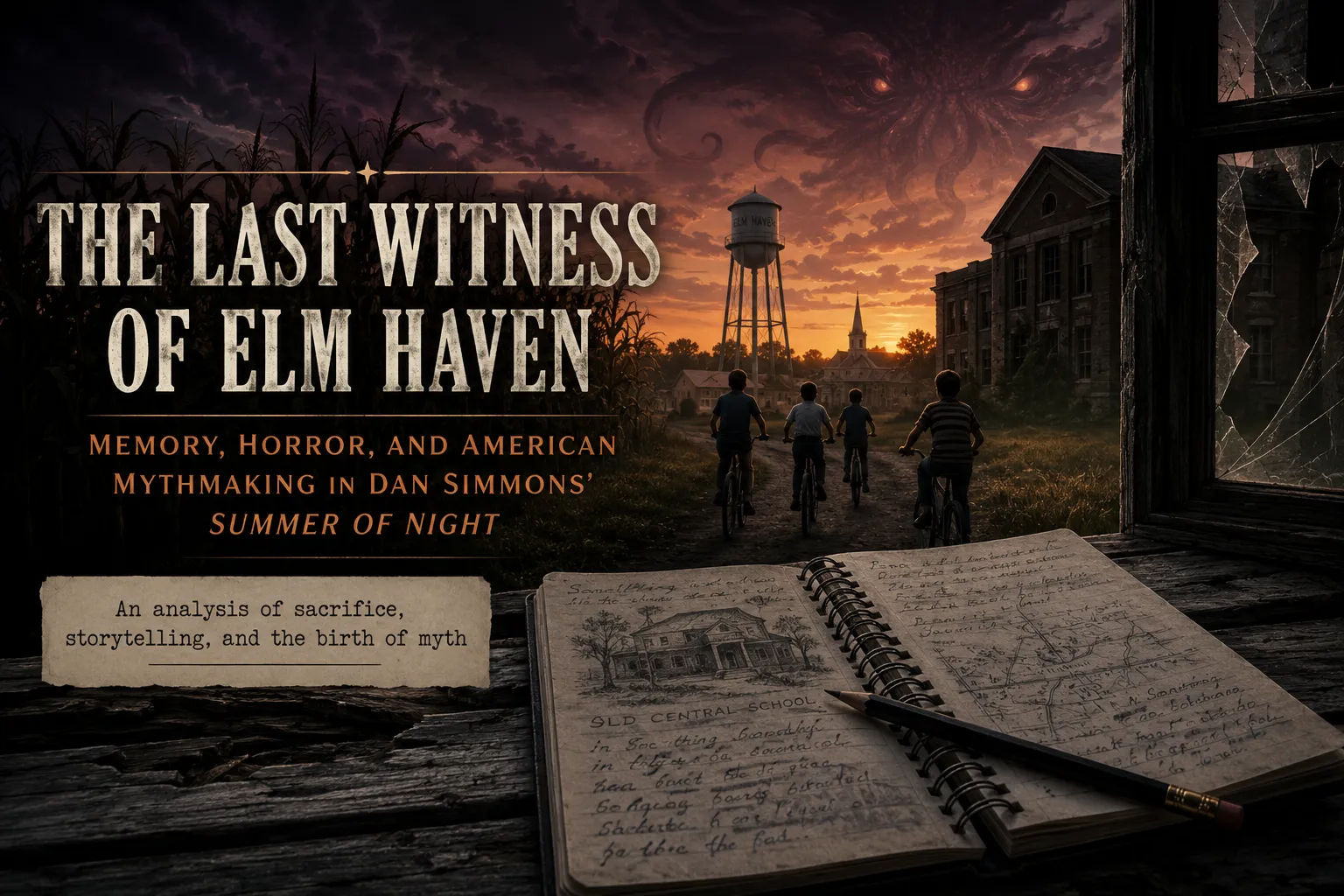
The function of horror in this novel is not simply to generate fear. It is to transform the ordinary into something sacred. Old Central School provides a particularly clear example. Before the supernatural events begin, it is merely a condemned building awaiting demolition. Once the horror manifests itself, the school becomes something else entirely: a repository of memory, history, and collective anxiety. The threat does not create meaning from nothing. It reveals the hidden significance of a place that had previously been taken for granted, investing it with a symbolic weight it did not previously possess.
The same process operates throughout Elm Haven. The possibility of loss transforms ordinary experiences into irreplaceable ones. Horror acts as a mechanism of sacralization — and in doing so, the novel suggests that communities often recognize the value of their own past only when confronted with the possibility of losing it.
Duane McBride and the Production of Memory
Within this symbolic system, Duane McBride occupies a singular position. Unlike the other boys, he is not defined primarily by courage, initiative, or leadership. What distinguishes him is his relationship to memory and narrative.
Duane emerges from a family whose members are themselves outsiders within the social landscape of Elm Haven. His father is both farmer and inventor, a practical experimenter whose intellectual independence sets him apart from conventional images of rural life. His uncle, by contrast, is an unconventional intellectual — a libertine fascinated by history, stories, and the persistence of the past. Together they provide Duane with an unusual inheritance: from his father, the habit of independent inquiry; from his uncle, an understanding that the past does not simply disappear but must be actively preserved. Writing becomes the place where these two legacies converge.
This is why Duane's ambition to become a writer is not an incidental character detail but the key to his narrative function. Where the other boys experience the events of that summer as participants, Duane experiences them simultaneously as material — as something that demands to be understood, recorded, and given form. The notebook he carries throughout the novel embodies this impulse. It is not merely a collection of observations or a practical tool for gathering information about the threat facing Elm Haven. It is an attempt to impose order on experience, to preserve fragments of meaning before they can be lost. While the other boys live the story, Duane is already trying to tell it. In this sense he becomes the novel's first archivist of horror.
The Notebook and the Survival of Meaning
The full significance of the notebook becomes apparent only after Duane's death. When Dale recovers and preserves the notes, the moment functions as one of the novel's most important acts of transmission. Dale does not inherit a weapon or a formula capable of defeating evil. He inherits a testimony — a record of how one person tried to make sense of events that resisted ordinary understanding.
What the notebook mediates is not simply information but the relationship between experience and memory. Through it, Duane continues to participate in the story even after his death: his observations shape how the remaining boys interpret what is happening, and his way of approaching events — his instinct to record, to analyze, to preserve — becomes a model for how the summer will eventually be remembered. His physical presence disappears. His narrative presence remains.
The notebook thereby assumes a quality that approaches, within the logic of the novel, the function of a relic. Not because it possesses any supernatural property, but because it preserves the voice of someone who can no longer speak — and because that preservation is precisely what allows individual experience to begin its transformation into something shared.
From Witness to Sacrifice
Marcel Mauss and Henri Hubert argued that sacrifice functions as a process of transformation rather than simple destruction: through the sacrificial act, something passes from one symbolic condition to another, acquiring in the process a different order of meaning. Duane's death operates according to this logic in ways that extend beyond the emotional register of loss.
Before his death, the strange events of that summer remain personal experiences — urgent and terrifying, but ultimately confined to those who are living through them. After his death, those experiences begin to acquire a different status. The summer ceases to be something that is happening and becomes something that must be remembered. The transformation is made possible precisely because Duane, as the character most oriented toward narrative and preservation, has already begun the work of turning experience into testimony. His death does not interrupt that work. It completes it — by making the transmission of the notebook not merely useful but necessary.
This is what the sacrificial logic illuminates: not simply that Duane dies, but that his death changes the status of everything that has been recorded. The witness disappears. The testimony survives. And because it survives in the hands of someone else — because Dale must now carry what Duane began — the memory of that summer becomes collective rather than individual. The myth of Elm Haven does not precede this act of transmission. It emerges from it.
Conclusion
The lasting power of Summer of Night derives not from its monster but from its understanding of how myth is made. Simmons transforms the ordinary landscape of Midwestern childhood into a mythic space not by idealizing it, but by exposing it to the possibility of loss — and by showing, through the figure of Duane McBride, that myth requires not only experience but someone willing to bear witness to it.
What the novel ultimately proposes is that collective memory is never simply a passive accumulation of shared events. It requires a founding act of transmission: someone who records, someone who dies, and someone who inherits the responsibility of keeping the record alive. Duane fulfills the first two functions. Dale fulfills the third. Together they enact the process through which a summer in Illinois becomes something larger than itself.
Horror, in this reading, is not the novel's subject but its instrument. The monster matters less than what it places at risk — and what survives.