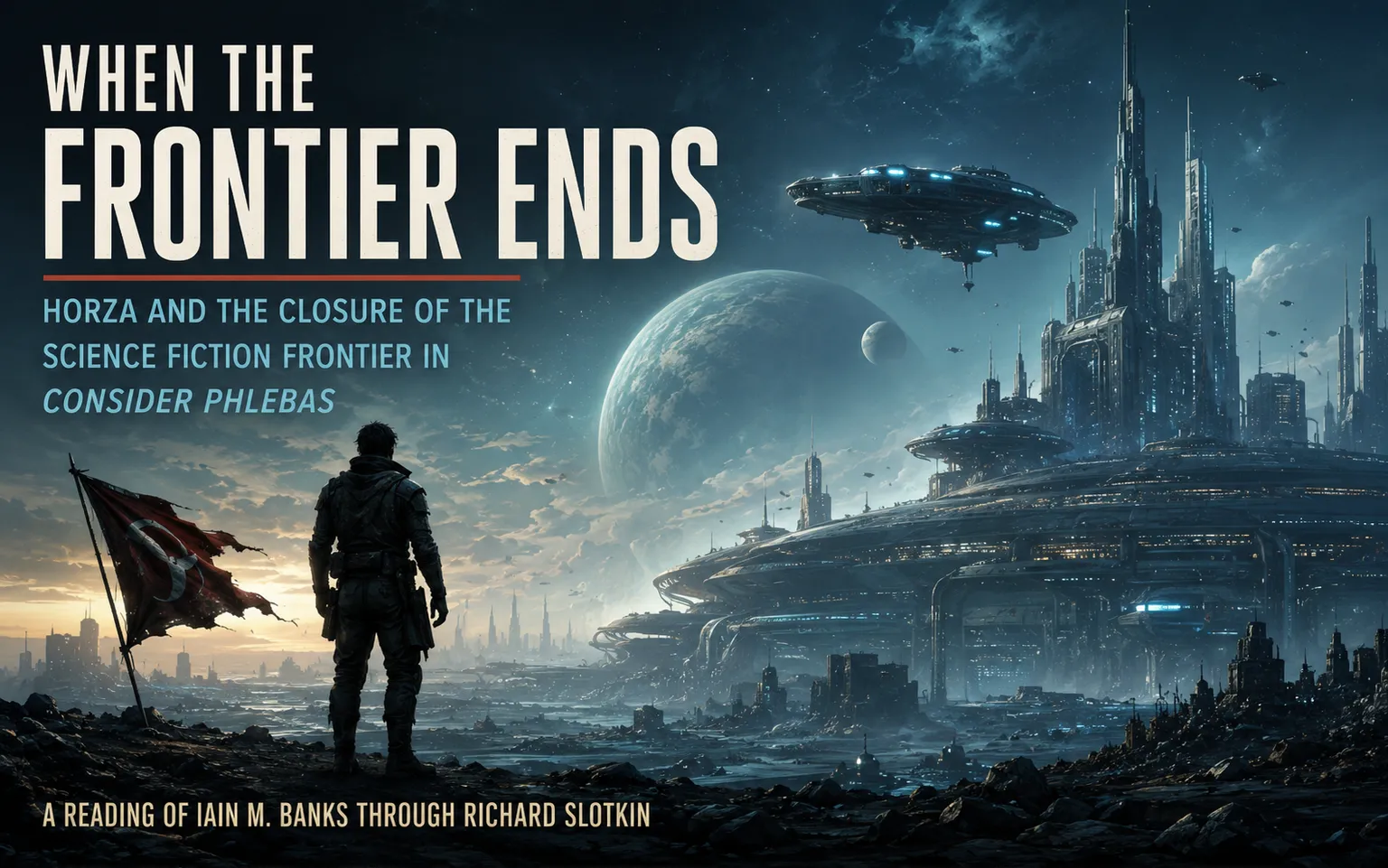
When the Frontier Ends: Horza and the Closure of the Science Fiction Frontier in Consider Phlebas
Introduction
Critical discussions of Consider Phlebas have traditionally focused on the Culture. The novel is commonly read as an exploration of post-scarcity economics, artificial intelligence, or Banks's political imagination. Such approaches are understandable. The Culture remains one of the most ambitious social constructions in modern science fiction, and its ideological implications are impossible to ignore. Yet these readings often overlook a different question: why does Banks choose Horza, an enemy of the Culture, as the principal viewpoint character of the first novel in the series?
This choice becomes particularly significant when situated within the history of science fiction itself. Rather than approaching Consider Phlebas primarily as a debate between political systems, it may be more productive to read it as a reflection on the fate of a particular kind of protagonist. Drawing on Richard Slotkin's analysis of the frontier myth, this essay argues that Consider Phlebas stages the closure of the science-fiction frontier — and that this closure is not merely a historical fact registered by the narrative, but a claim made by the Culture itself, on its own behalf. Horza is tragic not because his beliefs are necessarily mistaken, but because he embodies a form of heroism generated by the narrative and historical conditions of the Golden Age. By the late 1980s, those conditions had largely disappeared. What Banks dramatizes is therefore not merely a conflict between Horza and the Culture, but the encounter between a Golden Age hero and a universe that has already decided his story is over.
From Frontier Myth to Space Opera
In Slotkin's account of American cultural history, the frontier is not simply a geographical space. It is a narrative environment that produces specific forms of identity and heroism. The frontier hero emerges in situations where institutions are weak, danger is constant, and survival depends upon individual competence. Violence, risk, and self-reliance are not personal preferences but historical necessities. The hero exists because the environment requires him.
Crucially, Slotkin also emphasizes that the "closing" of the frontier was never a neutral fact simply observed by historians after the event. It was a declaration — most famously Turner's, in 1893 — made by the institutions that stood to benefit from it, retrospectively organizing the violence and improvisation of the frontier period into a completed, legitimating story. To declare the frontier closed is to perform an act of historical authority: it decides which forms of life belong to the past and which belong to the future, and it does so from the vantage point of whoever is doing the declaring.
Much of Golden Age science fiction reproduces the frontier structure itself on a cosmic scale. The frontier moves from the American West into interplanetary and interstellar space, but its narrative logic remains largely unchanged. Whether in the works of Heinlein, Anderson, or many of their contemporaries, the universe remains a place where capable individuals can shape history through courage, ingenuity, and decisive action. Space becomes the new frontier, and the science fiction hero becomes its explorer, defender, or conqueror.
This tradition established one of the central assumptions of classical space opera: that individual agency remains historically meaningful. The competent protagonist does not merely survive events. He helps determine them. It is precisely this assumption — and the authority to declare it no longer valid — that Banks places under pressure in Consider Phlebas.
Horza as the Last Frontier Hero
Horza belongs unmistakably to the older heroic tradition. Throughout the novel he displays precisely those qualities that Golden Age science fiction habitually celebrated. He is adaptable, resourceful, courageous, and deeply distrustful of large systems. His instinct is always to act rather than deliberate, to rely on personal judgment rather than institutional authority. Even his hostility toward the Culture reflects a frontier mentality. He distrusts a civilization that appears to have delegated human agency to vast technological systems and superhuman intelligences.
Importantly, Banks never treats these characteristics as laughable or morally suspect. Horza is not presented as a reactionary caricature. On the contrary, he remains one of the most capable figures in the novel. Readers are invited to admire his resilience, his determination, and even his loyalty to a cause that increasingly appears doomed. This sympathetic treatment is crucial because it reveals that Banks is not engaged in a simple ideological refutation. The novel respects the heroic tradition Horza represents even as it questions whether that tradition retains any historical jurisdiction.
The result is a protagonist who behaves like the hero of a different science-fiction era. He possesses all the traditional virtues, yet he inhabits a universe that no longer rewards them in the expected way — and, more pointedly, a universe whose dominant power has already ruled that such virtues belong to a closed chapter.
Schar's World and the Failure of Heroic Agency
This displacement becomes visible through the narrative itself. Horza's mission appears, at least initially, to follow the familiar structure of heroic adventure. A dangerous journey, a strategically vital objective, and a protagonist whose actions seem capable of influencing the course of a galactic conflict. Yet the novel repeatedly undermines this expectation.
The search for the fugitive Mind on Schar's World provides the clearest example. In a conventional Golden Age narrative, recovering such a crucial asset would almost certainly determine the larger outcome of the conflict. The hero's success or failure would carry direct historical consequences. Banks systematically frustrates this logic. Horza endures extraordinary dangers, survives a sequence of increasingly chaotic adventures, and ultimately reaches the object of his quest, only to discover that the significance traditionally associated with heroic achievement has evaporated. The war continues according to forces far larger than any individual actor.
A similar deflation occurs in Horza's encounters with Minds themselves. Where Golden Age narratives would typically stage the hero's confrontation with a powerful intelligence as a contest — of wits, of will, of moral standing — Banks repeatedly frames these encounters as asymmetries that barely register as contests at all. The Mind's perspective operates on a scale, and at a speed, that makes Horza's careful planning and physical risk almost beside the point before he has finished acting. The effect is not that Horza is humiliated, but that the entire grammar of confrontation — the assumption that hero and adversary meet on commensurable terms — fails to apply.
The same pattern recurs throughout the novel. Horza remains active, competent, and courageous, but his actions are increasingly absorbed into systems whose scale exceeds personal agency. The issue is not that he lacks heroic qualities. The issue is that history has ceased to operate according to the narrative assumptions that once made those qualities decisive.
His tragedy therefore resembles neither failure nor defeat in the conventional sense. Horza remains the same kind of hero he always was; it is the universe around him that has changed — and that change has already been ratified, elsewhere, as settled fact.
The Culture's Verdict on the Frontier
If Horza experiences this change as a kind of historical vertigo, the Culture experiences it as a foregone conclusion. This is the sense in which the Culture functions as the narrative equivalent of the closed frontier — not simply a civilization in which scarcity has been overcome and decision-making delegated to distributed intelligences, but a civilization that holds the pen. It is the Culture's vantage point from which Horza's world looks like prehistory, much as Turner's 1893 frontier thesis required a vantage point — the settled, industrialized East — from which the frontier could be pronounced finished.
The problem is not that figures like Horza become morally wrong. Rather, they become, from the Culture's perspective, historically unnecessary — and the Culture's overwhelming material and informational superiority means that its perspective is not merely one interpretation among others. It is, for practical purposes, the one that prevails. This is what gives Horza's conflict with the Culture a charge that exceeds ordinary political disagreement. He is not simply losing an argument about values. He is on the losing side of a declaration about which stories still count as history.
From Revisionist Western to New Space Opera
Read through Slotkin, the affinity between Consider Phlebas and the revisionist western becomes more than an evocative parallel. Slotkin's own analyses of the Western genre describe how films repeatedly stage the moment at which the frontier's "closure" arrives as an external verdict — delivered by railroads, by fences, by federal marshals — against protagonists who never asked to be tried. Films such as My Name Is Nobody and Unforgiven dramatize exactly this: their gunfighters are not refuted from within, but rendered obsolete by a world that has, elsewhere and without consulting them, decided the frontier is over.
Banks performs a structurally similar operation within science fiction, with the Culture occupying the position of the encroaching modern order. Horza's virtues remain real, but the historical circumstances that once made those virtues central have been declared, by the Culture, to have ended. The emotional force of the novel derives from this tension. Banks neither celebrates nor condemns the passing of the older heroic order. Instead, he treats it with a mixture of admiration, melancholy, and historical acceptance — while leaving visible the fact that this acceptance is also, in part, something imposed.
This is why Consider Phlebas often feels elegiac rather than triumphalist. The novel does not simply announce the arrival of the Culture. It pauses to acknowledge what must be left behind — and by whom that leaving-behind is decided — in order for such a future to exist.
The Sentence Carried Out
If the Culture's verdict on the frontier is, in the first instance, a declaration — a claim about which kind of world has ended — the novel does not leave that claim suspended in the abstract. Horza dies. And his death is not incidental to the argument this essay has been making; it is its completion. A declaration of closure and the execution of that closure are not the same act, even when the same power performs both. Turner could pronounce the frontier finished from a lecture podium without anyone needing to die for the pronouncement to take effect, because by 1893 the work of closing — the wars, the displacements, the fences — had already been done elsewhere, by other hands, over decades. Consider Phlebas compresses declaration and execution into a single narrative arc, and Horza's death is where that compression becomes visible.
It matters, in this light, that Horza's death is neither a battlefield climax nor a moment of dramatic reversal. It occurs almost as an afterthought to events that have already moved beyond him — fittingly, given everything the novel has shown about the relationship between his actions and their historical weight. The sentence is carried out not with ceremony but with the same indifference that has characterized the Culture's relation to Horza throughout: he is not important enough to be defeated dramatically. He simply ceases to be relevant, and then he is dead. The closure that the Culture's existence had already implied, and that this essay has read as a kind of verdict, here stops being a matter of interpretation and becomes a fact on the ground — the frontier hero's death is what a closed frontier looks like from the inside.
This is also where Banks's refusal of irony becomes most consequential. A more dismissive novel might have used Horza's death to deliver a final judgment on his worldview — proof, in retrospect, that he was wrong all along. Consider Phlebas does not take this route. The death is not a punchline. It carries the same dignity the novel has granted Horza throughout, which is precisely what makes it function as execution rather than refutation: the sentence is carried out on a man the novel has never stopped respecting. The verdict, in other words, was never really about Horza's worth. It was about whether the world still had a place for someone like him — and his death is the answer.
Conclusion
Reading Consider Phlebas through the lens of the frontier myth shifts attention away from the familiar ideological debates surrounding the Culture and toward a broader question about the history of science fiction itself. The novel's central drama is not simply the conflict between two civilizations but the encounter between two narrative paradigms — one of which has the power to declare the other finished. Horza embodies the assumptions that sustained the heroic imagination of the Golden Age, while the Culture represents a world that has not merely outgrown those assumptions but has pronounced them obsolete, much as Turner once pronounced the frontier closed from the safety of its aftermath.
What Banks offers is neither a rejection nor a celebration of the older tradition. Instead, he stages its sentencing. If the frontier can only ever be declared closed by those who no longer need it — and never by those still living inside it — what does it mean for science fiction to keep telling stories from the side that lost that argument?