The Isolated Family and the Collapse of Community in The Shining
Introduction
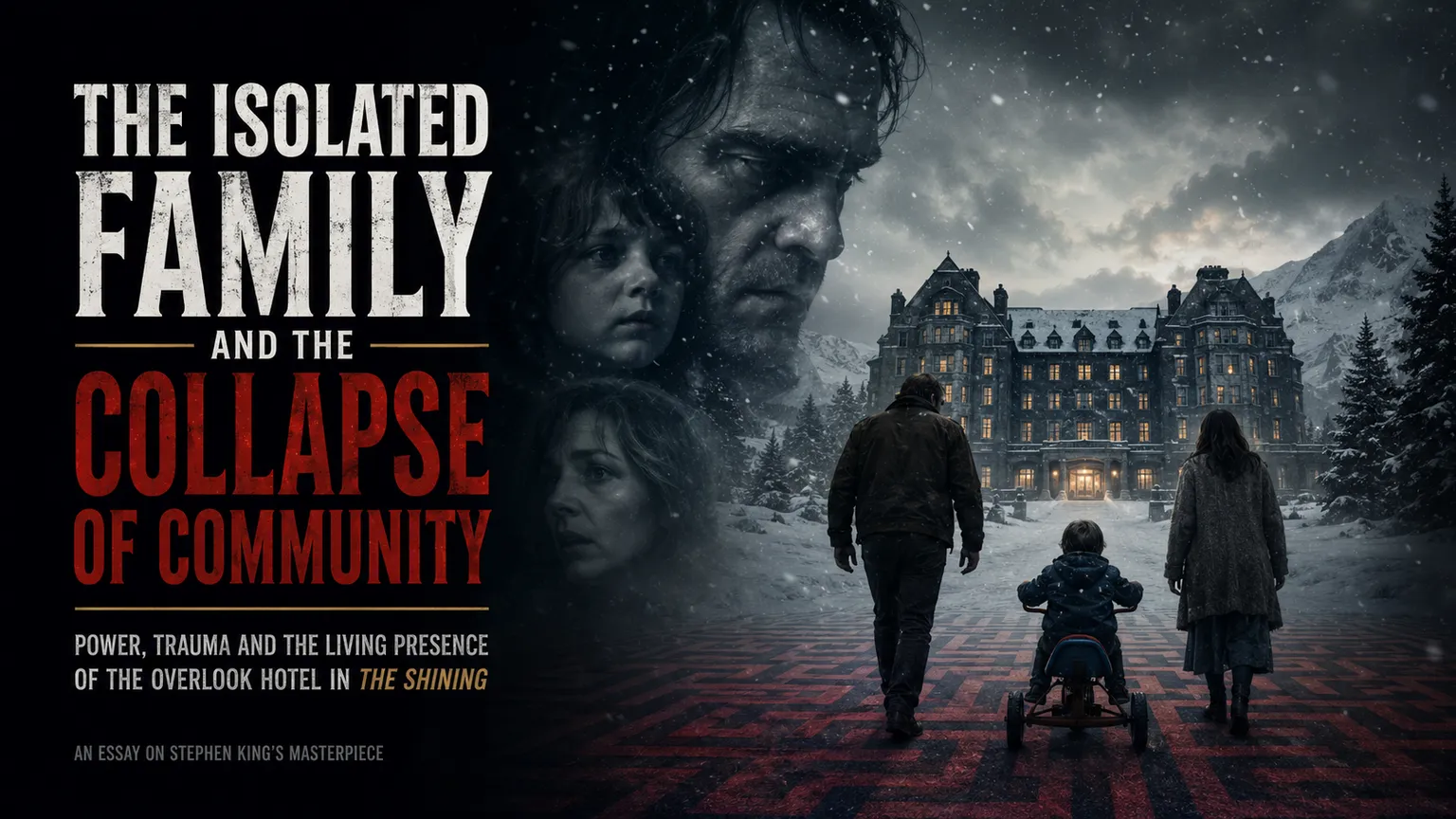
In Stephen King's The Shining, horror does not truly originate from the ghosts of the Overlook Hotel. The supernatural is certainly present, but it mainly acts as a force of amplification. At the core of the novel lies the slow disintegration of an already fragile family once it becomes separated from the wider human community.
Isolation, in King's novel, is neither liberating nor regenerative. On the contrary, it produces implosion. In this sense, The Shining radically overturns the Rousseauian myth of the return to nature: far from society, human beings do not rediscover their original innocence, but instead lose the structures that once contained their violence.
The Family as an Incomplete Community
The Torrance family arrives at the Overlook already fractured. Jack is a man damaged by alcoholism, professional failure, and a rage he can no longer control. Wendy lives in a precarious balance of fear, emotional dependence, and constant denial. Danny absorbs every familial tension with an almost pathological sensitivity.
The novel demonstrates with remarkable clarity that the nuclear family is not a self-sufficient organism. It functions only as long as it remains embedded within a broader social network composed of work, school, friendships, neighborhood life, daily routines, and mutual supervision.
When the Torrances become trapped in the Overlook during winter, all of this disappears. The family is left alone with itself. Absolute solitude allows the tensions already present within the family to expand unchecked.
Isolation as an Accelerator of Violence
The Overlook does not create evil from nothing. It amplifies what is already there.
In the outside world, Jack Torrance is still subject to social limits: he must work, interact with other people, fear public judgment, and at least superficially obey certain rules of coexistence. In total isolation, these structures evaporate. His mind becomes a sealed psychological space where every frustration reverberates endlessly, unchecked by any external force.
Far from evoking untouched nature or the romantic silence of the winter landscape, the snow functions as a social barrier, erasing every connection with the human world and transforming the Overlook into a fortress outside time. Within this closed environment, the family gradually ceases to function as an emotional community and instead becomes an authoritarian structure.
Jack progressively attempts to reassert his role through control over space, language, and ultimately the lives of his wife and son. Part of the horror of the novel emerges from this transformation of the father figure into absolute power.
The Overlook as a Living Organism
In King's fiction, objects and places are rarely neutral. They absorb memory, emotion, and violence until they become living organisms. The Overlook Hotel is perhaps one of the clearest expressions of this idea. It is not merely a haunted building, but a true character endowed with memory, will, and hunger.
The hotel preserves traces of the people who passed through it and continuously reshapes them. It is not simply a container for events, but a machine that accumulates history. Behind the elegance of its halls and corridors lies a long sedimentation of violence, class hierarchy, abuse, alcoholism, and social domination.
King suggests that places retain the cultural tensions that produced them. The Overlook thus becomes a kind of material unconscious of America itself. The ghosts inhabiting the hotel are not abstract demons, but the return of historical violence embedded within the structures of American society.
It is no coincidence that the Overlook seduces Jack by promising him what he feels he has lost: prestige, authority, belonging, and continuity with a patriarchal tradition of power. The hotel offers him the illusion of no longer being a failure. In return, it demands total assimilation.
The Overlook and the Illusion of Belonging
Another crucial aspect of The Shining is that the Torrance family does not arrive at the Overlook as guests, but as workers. They are not participants in the world the hotel celebrates; they exist behind its spectacle, maintaining the machinery of representation while remaining excluded from it.
This detail profoundly changes the social meaning of the novel.
The Overlook is not simply a haunted building or a corrupted domestic space. It is a structure built around wealth, prestige, class hierarchy, and ritualized performances of status. Even empty, the hotel continues to stage the image of privilege. The ballroom, the bar, the luxurious corridors, and the ghostly parties all preserve the illusion of an eternal upper-class world that survives beyond the people who once inhabited it.
The Torrances occupy this world without truly belonging to it. They live inside the spectacle while remaining invisible to it.
This contradiction is especially destructive for Jack. The hotel constantly offers him the fantasy of inclusion: recognition, authority, masculine prestige, and symbolic importance. Yet this promise is fundamentally false. Jack is not one of the guests celebrated by the Overlook’s history. He is part of the labor force that keeps the structure functioning.
The horror of the novel emerges partly from this tension between exclusion and identification. Jack desperately wants to cross the boundary separating him from the world the hotel represents. He no longer wants to feel like a failed teacher, a failed writer, or a socially diminished man standing behind the scenes of power. The Overlook seduces him by allowing him to imagine himself as part of the ruling spectacle rather than its servant.
But the hotel can only offer a distorted parody of social ascent. It grants Jack the performance of authority while simultaneously consuming him as a disposable figure within its system.
In this sense, the Overlook functions not only as a supernatural entity, but also as a cultural machine reproducing social hierarchy and domination. The family is isolated not in nature, but within a symbolic structure already saturated with ideology, class tension, and historical violence.
Perhaps this is why Jack ultimately collapses: he can no longer distinguish between his own desires and the role the hotel demands that he perform.
The Repetition of Trauma
One of the novel’s most tragic aspects is that Jack, raised by an abusive and alcoholic father, slowly ends up reproducing the very model he always hated. Isolation destroys the illusion that one can break the cycle of familial violence alone. The Overlook accelerates this process by transforming trauma into repetition.
Danny perceives all of this before anyone else. His “shining” can also be interpreted as an extreme form of childhood hypersensitivity. Like many children raised in unstable households, Danny understands tensions and dangers that adults pretend not to see.
The novel therefore suggests an unsettling truth: children often do not ignore family violence — they understand it far too well.
Conclusion
Read today, The Shining appears as far more than a simple horror novel. It becomes a reflection on the fragility of the modern family and on the illusion of individual self-sufficiency. King shows how human beings require community, external relationships, and shared limits in order to prevent private tensions from turning into destruction.
The Overlook Hotel pushes this dynamic to its extreme consequences. It is not merely a haunted place, but the symbol of a society that accumulates violence and eventually returns it in the form of trauma, domination, and repetition.
Within the closed world of the hotel, the Torrance family gradually ceases to be a space of protection and instead becomes an isolated system collapsing in on itself. Perhaps this is the novel’s most disturbing idea: evil does not always arrive from the outside. Sometimes it slowly emerges from what a fragile community was desperately trying to keep hidden.