Dawn by Octavia Butler Between Herbert Marcuse and Donna Haraway: The Posthuman as Liberation and Domination
Introduction
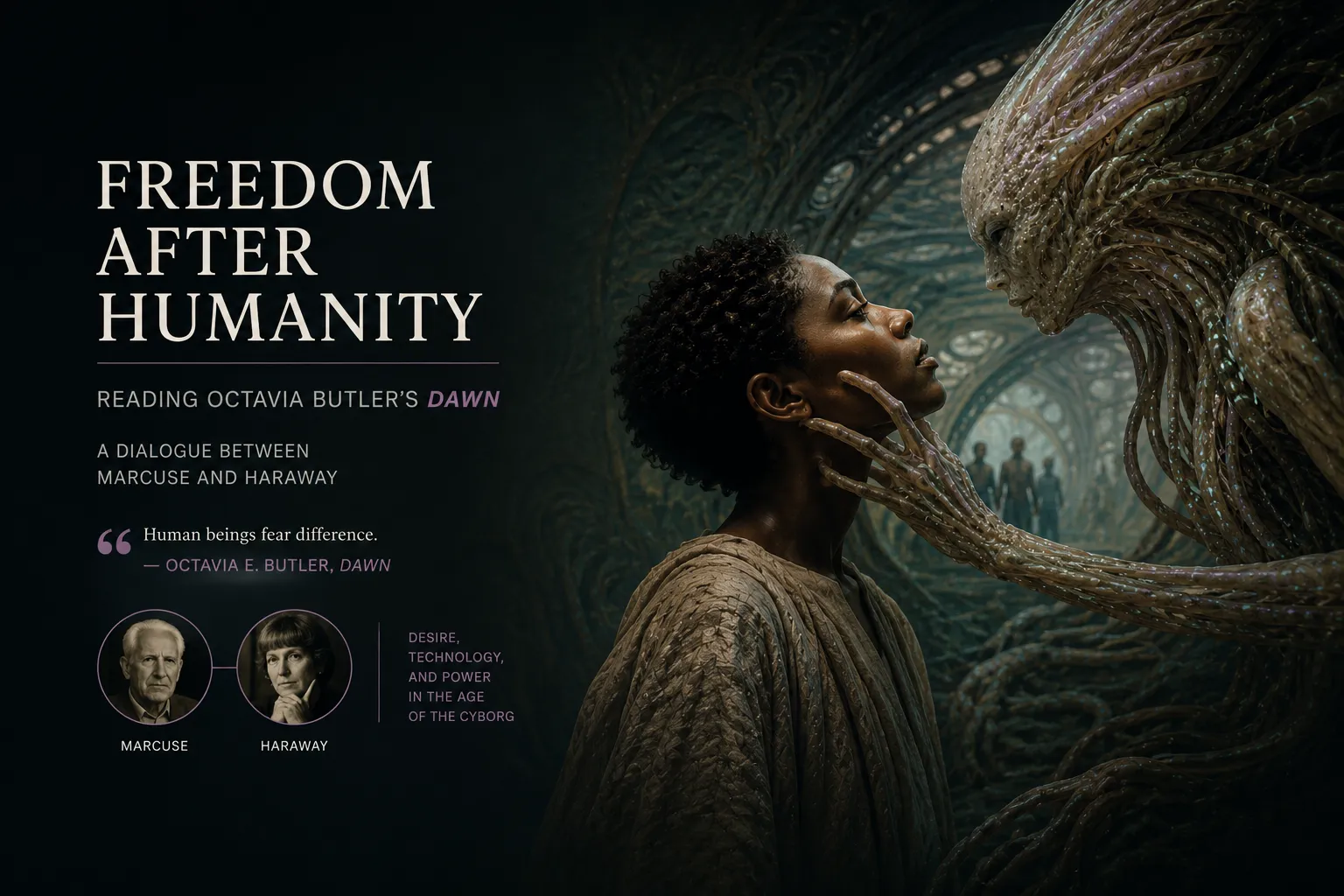
Among the major works of contemporary science fiction, Dawn occupies a singular position. Published in 1987 as the first volume of the Xenogenesis trilogy — later collected under the title Lilith's Brood — the novel uses the classic premise of alien contact to challenge some of the foundational assumptions of Western modernity: individual identity, bodily autonomy, freedom, desire, and even the stability of the category we call “human.”
The premise is deceptively simple. After a nuclear war devastates Earth, the few surviving humans are rescued by the Oankali, an alien species defined by sensory tentacles, organic biotechnology, and a civilization built entirely around genetic exchange and hybridization. Yet the Oankali do not intend to restore humanity to its previous condition. Their project is transformation.
At this point, Dawn ceases to function as a conventional first-contact narrative and becomes something far more unsettling. Butler imagines a civilization that appears to fulfill many of the promises associated with posthuman and anti-repressive thought — the dissolution of rigid identities, the collapse of binary oppositions, the integration of body and technology — while simultaneously revealing how those same processes can generate new forms of biological domination.
Read today, the novel enters into a productive dialogue with two seemingly distant thinkers: Herbert Marcuse and Donna Haraway. Marcuse offers a framework for understanding Butler’s critique of repressive civilization and hierarchical violence, while Haraway provides the conceptual vocabulary necessary to interpret the dissolution of stable identities and the emergence of posthuman subjectivity.
The racial and colonial dimensions of the Oankali project — particularly its proximity to forms of biologically enforced assimilation and racialized eugenics — have rightly become central to much contemporary criticism surrounding Dawn. Butler’s novel repeatedly evokes the language of colonial domination, reproductive control, and the violent management of human difference.
This article does not seek to dismiss those readings, but rather to temporarily set them aside in order to focus on another tension running through the novel: the relationship between posthuman transformation, desire, and the crisis of autonomy.
Butler ultimately imagines the posthuman not as a clean escape from domination, but as a condition in which liberation and control become increasingly difficult to separate. The dissolution of fixed identity may free humanity from older hierarchical structures, yet it also opens the possibility of new forms of biological and psychological governance.
In Dawn, liberation from fixed identities always coincides with a crisis of individual autonomy.
The End of the Humanist Subject
One of the novel’s most compelling achievements lies in the way it dismantles the modern image of the autonomous individual. Western humanism traditionally imagines the subject as rational, self-contained, distinct from the surrounding world, and sovereign over its own body. The Oankali gradually erode each of these assumptions.
For them, the body is neither stable nor inviolable, but perpetually transformable. Species does not constitute a fixed boundary. Identity remains fluid. Even desire emerges as relational and mutable rather than private or self-generated.
This is where the connection with Donna Haraway becomes especially illuminating. In A Cyborg Manifesto, Haraway describes the cyborg as a figure that dissolves the defining oppositions of modernity: human and machine, natural and artificial, organism and technology. The cyborg is less a technological entity than a crisis of pure identity itself.
The Oankali embody this logic completely. Their civilization recognizes no stable categories because it is founded entirely upon hybridization.
Lilith Iyapo, the novel’s protagonist, experiences this process as both transformation and dislocation. She gradually ceases to belong fully to humanity without ever truly becoming Oankali. She inhabits an unstable threshold between species, identities, and forms of embodiment.
That suspension becomes the novel’s deepest source of horror. The terror of Dawn does not arise solely from alien otherness, but from the realization that “the human” may never have been a stable category in the first place.
Marcuse and the Critique of Human Civilization
If Haraway helps illuminate the collapse of stable identity, Herbert Marcuse provides another key to the novel: the critique of civilization itself.
In Eros and Civilization, Marcuse argues that modern society is built upon the repression of desire and the disciplining of the body. Industrial civilization produces subjects separated from sensuality and subordinated to systems of productivity, hierarchy, and control.
The Oankali appear to recognize precisely this pathology within humanity. According to them, human beings are doomed by a destructive combination of intelligence and hierarchical aggression. As one Oankali tells Lilith: “You’re intelligent, but you’re hierarchical.” Nuclear war therefore appears not as a historical accident, but as the logical outcome of a civilization organized around domination.
The novel also resonates strongly with Marcuse’s later work, One-Dimensional Man. There, Marcuse describes a society that produces individuals incapable of imagining genuinely different forms of existence. Human beings become trapped inside the structures of domination so thoroughly that they continue reproducing them even after the original social systems collapse.
Butler’s surviving humans embody this condition with disturbing clarity. Even after apocalypse — without states, institutions, or industrial infrastructure — they immediately reconstruct hierarchy, violence, and authority. Their response to crisis is not reinvention, but repetition.
The Oankali thus function as a living critique of the civilization Marcuse describes. Yet Butler refuses any simplistic opposition between “corrupt humanity” and “evolved alien civilization.” The novel remains fundamentally ambiguous. The Oankali may offer a path beyond hierarchy and violence, but that path demands the surrender of biological and cultural autonomy.
The Body as a Site of Power
One of the most disturbing dimensions of Dawn concerns the relationship between pleasure, desire, and control.
Marcuse imagined the possibility of a less repressive civilization grounded in an erotic reconciliation with the world. In his work, Eros signifies more than sexuality; it represents a non-dominating mode of relation, a different way of inhabiting both the body and the social world.
Initially, the Oankali appear to embody such a possibility. Their society does not divide knowledge from sensuality, technology from the body, or communication from pleasure. Desire seems fluid, non-possessive, and free from the rigid structures governing human sexuality.
But Butler introduces a deeply unsettling reversal. Within the Oankali world, desire itself becomes biologically malleable. Attraction can be induced. Fear can be chemically neutralized. Pleasure can be transformed into dependency. Power no longer operates primarily through repression; it works through the production and management of desire itself.
Here the novel becomes extraordinarily contemporary. Domination no longer relies chiefly on law or direct force, but on the regulation of biological processes: reproduction, neurochemistry, emotional attachment, and genetic inheritance. The liberated body simultaneously becomes the governable body.
Organic Technology and the Posthuman
The relationship between organism and technology is radically redefined throughout Butler’s novel.
Classical science fiction often presents technology as something external to the human body: machines, mechanical systems, computational devices. The Oankali operate according to an entirely different logic. Their technology is organic. Their ships are living organisms. Knowledge is biologically embedded. Genetic manipulation replaces mechanical engineering. The body itself becomes technological infrastructure.
Here Butler pushes many of Haraway’s insights toward their most unsettling implications. In A Cyborg Manifesto, the cyborg symbolizes the collapse of the boundary separating machine from organism. In Dawn, that collapse ceases to be metaphorical and becomes biological reality.
Haraway’s concept of situated knowledge also becomes relevant here. Knowledge is never abstract or disembodied, but always produced through a specific material position. The Oankali embody this principle in radical form: their understanding of the universe is inscribed directly into their biology. They do not merely study genetics; they exist as genetics.
Knowledge, for them, becomes indistinguishable from flesh.
Yet Butler never romanticizes this posthuman condition. Once technology fully penetrates living existence, there is no remaining “outside” from which resistance can emerge. Colonization becomes biological.
The Crisis of Consent
Perhaps the novel’s most devastating question concerns the nature of consent itself.
Liberal modernity depends upon the idea of the autonomous individual capable of making free choices. Butler systematically destabilizes that assumption. What does freedom mean when desire itself can be manipulated? When the body undergoes genetic alteration? When attraction and emotional attachment become controllable biochemical processes?
The humans in Dawn are not simply conquered. They are transformed so deeply that the distinction between choice and conditioning begins to erode.
This is precisely what makes the Oankali so disturbing. They are not conventionally sadistic. In many respects they appear compassionate, patient, and even nurturing. Yet their biological paternalism renders any truly equal relationship impossible.
The tension becomes clearest in Lilith’s relationship with the ooloi, the third Oankali sex capable of directly manipulating neurochemistry and sensation. The ooloi do not merely seduce or persuade. They intervene directly within the nervous system, generating pleasure, attachment, dependency, and altered emotional states.
Lilith’s attraction to them can never be understood as fully voluntary because her own desires are being biologically reshaped throughout the process. Butler pushes this ambiguity to deeply uncomfortable limits. The intimacy offered by the Oankali is genuine, but so is the loss of autonomy embedded within it.
At this point, Dawn becomes philosophically devastating. Once desire itself becomes programmable, the classical liberal distinction between freedom and coercion begins to collapse. Butler suggests that the dissolution of the autonomous subject may free humanity from certain oppressive structures of modernity while simultaneously destabilizing the very possibility of freedom itself.
Lilith and the Contradiction of the Posthuman
Lilith’s position within the novel ultimately prevents Dawn from becoming either a nostalgic defense of humanity or a utopian celebration of the posthuman.
She recognizes the violence embedded within human civilization, yet she also perceives the quiet coercion concealed within the Oankali project. This double awareness reaches its most painful expression when Lilith agrees to help prepare other surviving humans for life among the Oankali — an act she describes with bitter clarity:
“I’ll do what they want. But I won’t pretend I like it.”
The statement captures her condition with devastating precision. Lilith neither openly resists the Oankali nor fully surrenders to them. She negotiates, endures, and preserves a form of internal dissent that the Oankali can reshape biologically but never entirely extinguish.
This is precisely what makes her such a powerful protagonist. Through Lilith, Butler suggests that the posthuman condition is not a clean transcendence of the human, but an unstable territory in which identity, desire, embodiment, and freedom can no longer be cleanly separated.
Conclusion
What allows Dawn to endure is not simply its originality as science fiction, but its refusal to provide ideological comfort.
The novel imagines a world beyond many of the structures traditionally associated with Western humanism: rigid identities dissolve, the boundary between organism and technology collapses, and hierarchy itself appears open to transformation. In this sense, Butler’s work resonates strongly with both Marcuse’s critique of repressive civilization and Haraway’s vision of posthuman hybridity.
Yet Dawn never allows these possibilities to become purely emancipatory. The same processes that promise liberation also generate new forms of dependency and control. The body becomes more fluid, but also more governable. Desire becomes more open, but increasingly programmable. Identity becomes relational, but also profoundly unstable.
What Butler ultimately exposes is the terrifying ambiguity at the center of the posthuman imagination: the possibility that freedom and domination may no longer appear as opposites.
The Oankali believe humanity is doomed by its own hierarchical nature. Butler leaves us with a far more unsettling question: if the human subject itself is inseparable from structures of domination, what would liberation actually look like?
Bibliography
- Dawn. New York: Warner Books, 1987.
- Adulthood Rites. New York: Warner Books, 1988.
- Imago. New York: Warner Books, 1989.
- Lilith's Brood. New York: Grand Central Publishing, 2000.
- Eros and Civilization. Boston: Beacon Press, 1955.
- One-Dimensional Man. Boston: Beacon Press, 1964.
- A Cyborg Manifesto. In Simians, Cyborgs, and Women: The Reinvention of Nature. New York: Routledge, 1991.